BFI - Seed Plants, Fruit/Seed Reproduction, Relationships & Interactions
 Call Kai
 Learn
 Practice Test
 Spaced Repetition
 Match
 Flashcards
 Knowt Play
1/72

Earn XP
73 Terms
What is an angiosperm?
A type of plant that can be distinguished by three key features:
a) Flowers
b) Fruits
c) double fertilization
Sepals
modified leaves which enclose flower
Calyx
All sepals of a flower
Petals
Modified leaves that function to attract pollinators
Corolla
all petals of a flower together
Stamens
contains anthers and produces pollen
Androecium
All stamens of a flower
Carpels
Produces ovules and receives pollen
Parts of stamen
Filament and anther
Parts of a carpel
ovary at base, style, and stigma at top
What is a complete flower?
A flower which contains all four floral organs
What is an incomplete flower?
a flower that lacks one or more floral organs
What are the two group types of flowers?
Single - only one flower is produced
Inflorescences - Clusters of flowers are produced from one stem
Types of flower symmetry
Radial and bilateral
Five stages of angiosperm life development
A. Gametophyte development
B. Pollination
C. Double fertilization
D. Seed development
E. Fruits
Pollen develops from…
microspores within the microsporangia of anthers, made of gametophyte and spore wall
How does a microspore develop into pollen grains?
Each undergoes mitosis to produce a generative cell (forms two sperm) and a tube cell which surrounds it
Embryo sac develops within the…
ovule, within it two integuments surround the megasporangium
How are megaspores produced?
Inside megasporangium, one cell undergoes meiosis, producing four megaspores, only one of which survives
What cells are found inside megasporangium after mitosis?
1 egg and 3 antipodal cells, 2 synergids, 2 polar nuclei
Synergids
help attract and guide pollen tube to embryo sac
antipodal cells
unknown function
polar nuclei
help in formation of endosperm
Pollination
the transfer of pollen from an anther to a stigma
After landing on a receptive stigma, a pollen grain produces a
pollen tube that grows down into the ovary
types of pollinators
wind (20%), bees (65%), and other animals
Double fertilization
refers to the process where two pollen grains are released into ovary, one will fertilize egg to form zygote and the other fertilizes polar nuclei to form endosperm
What n level is the endosperm?
3n (Triploid)
through what does the pollen grain enter the ovary?
Micropyl (small opening)
What are the two main developmental groups of angiosperms?
Eudicot and monocot
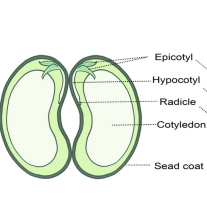
What kind of embryo is this?
Dicot embryo
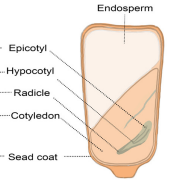
What kind of embryo is this?
Monocot embryo
Features of dicot embryo
Seed coat, epicotyl, hypocotyl, radicle and cotyled, two main bodies
Features of monocot embryos
Scutellum, pericarp with seed coat, coleoptile, epicotyl, hypocotyl, radicle, coleorhiza, one main body
Monocot Embroys
one cotyledon
Monocot Leaf veination
parallel veins
Monocot stem tissues
vascular tissues scattered
Monocot roots
system of fibrous roots
dicot leaf veination
netlike veins
dicot embryos
two cotyledons
dicot stem tissues
vascular tissues arranged in ring
dicot roots
taproot as main root
monocot pollen
pollen grain has one opening
dicot pollen
pollen grain has three openings
monocot flowers
floral organs in multiples of three
dicot flowers
floral organs in multiples of four or five
coleoptile
covers young shoot
coleorhiza
covers young root
two types of germination
epigeal and hypogeal
epigeal germination
cotyledon is thrown above ground
hypogeal germination
cotyledon stays below ground
purpose of fruit
protects seeds, aids in dispersal, carries nutrients for zygote
how can seeds be carried
wind, water, animals
Types of fruits
simple, aggregate, multiple, accessory
simple fruit
develops from single or several unfused carpels
aggregate fruit
develops from single flower with multiple separate carpels
mutliple fruits
develops from multiple flowers (inflorescence) into single fruit body
Accessory fruits
contains other floral parts in addition to ovaries (ex. apples)
Why do plants form relationships with other organisms
gives nutrients (ex. sugars, amino acids) and receives help in growth (ex. antibiotics, chemicals, waste removal)
Types of mutualistic bacteria
rhizobacteria and endophytes
rhozobacteria
lives in layer of soil around plant roots (rhizosphere) and exchanges nutrients with root cells
endophytes
lives between cells of plant host, exchanges nutrients
Nodules
cells that contain nitrogen-fixing bacteria (now called bacteriods)
How many ATP do bacteria need to convert N2 to NH4+?
8
How do nitrogen-fixing bacteria help plants?
Obtains sugars from plant and fixates nitrogen
Benefits of crop rotation
Because each species of plant has its own species of Rhizobium, rotating plant types allows for different nutrients to be used/created
Two types of mycorrhiza
ectomycorrhiza and arbuscular mycorrhiza
Ectomycorrhiza
exchanges nutrients along outside layer of root cells
Arbuscular mycorrhiza
grows into root cells for direct nutrient transfer
Non-mutualistic relationship types
epiphytes, parasites, and carnivorous
epiphytes
grows on another plant to obtain water from rain
parasitic plants
obtain sugars/minerals from host plants
carnivorous
obtains nitrogen by digesting insects