Endocrine System

0.0(0)
Studied by 0 people
call kaiCall Kai
learnLearn
examPractice Test
spaced repetitionSpaced Repetition
heart puzzleMatch
flashcardsFlashcards
GameKnowt Play
Card Sorting

1/34

encourage image

There's no tags or description

Looks like no tags are added yet.

35 Terms

1
New cards

Endocrine glands

Spread throughout the body and is composed of various glands that secrete hormones.

<p>Spread throughout the body and is composed of various glands that secrete hormones.</p>
2
New cards

Adrenal gland

Located above each kidney.

It secretes many hormones, including the precursor sex hormones, cortisol, and aldosterone from the cortex of the adrenal gland. Different hormones are released from the cortex as compared to the medulla.

The hormones secreted from the medulla of the adrenal gland include adrenaline (epinephrine) and noradrenaline (norepinephrine), which are responsible for the fight or flight response.

<p>Located above each kidney. </p><p>It secretes many hormones, including the precursor sex hormones, cortisol, and aldosterone from the cortex of the adrenal gland. Different hormones are released from the cortex as compared to the medulla. </p><p>The hormones secreted from the medulla of the adrenal gland include adrenaline (epinephrine) and noradrenaline (norepinephrine), which are responsible for the fight or flight response.</p>
3
New cards

Brain

Contains the hypothalamus, pituitary gland, and pineal gland.
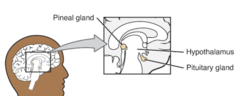
<p>Contains the hypothalamus, pituitary gland, and pineal gland.</p>
4
New cards

Hypothalamus

Brain structure that serves as the main link between the nervous system and the endocrine system, maintaining homeostasis by producing hormones that regulate the pituitary gland and other endocrine functions.

<p>Brain structure that serves as the main link between the nervous system and the endocrine system, maintaining homeostasis by producing hormones that regulate the pituitary gland and other endocrine functions.</p>
5
New cards

Pituitary gland (anterior & posterior)

The "master gland," is a pea-sized gland at the base of the brain that regulates many bodily functions through hormones. It is controlled by the hypothalamus and produces hormones that manage growth, metabolism, reproduction, stress response, and the functions of other endocrine glands like the thyroid and adrenal glands.

<p>The "master gland," is a pea-sized gland at the base of the brain that regulates many bodily functions through hormones. It is controlled by the hypothalamus and produces hormones that manage growth, metabolism, reproduction, stress response, and the functions of other endocrine glands like the thyroid and adrenal glands.</p>
6
New cards

Anterior pituitary gland

Produces and releases six key hormones: adrenocorticotropic hormone (ACTH), prolactin (PRL), growth hormone (GH), thyroid-stimulating hormone (TSH), luteinizing hormone (LH), and follicle-stimulating hormone (FSH). Located at the base of the brain, it is controlled by the hypothalamus.
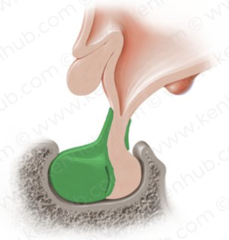
<p>Produces and releases six key hormones: adrenocorticotropic hormone (ACTH), prolactin (PRL), growth hormone (GH), thyroid-stimulating hormone (TSH), luteinizing hormone (LH), and follicle-stimulating hormone (FSH). Located at the base of the brain, it is controlled by the hypothalamus.</p>
7
New cards

Posterior pituitary gland

It is a collection of nerve endings from the hypothalamus that stores and releases two key hormones: antidiuretic hormone (ADH), which helps regulate water balance, and oxytocin, which plays a role in uterine contractions.

<p>It is a collection of nerve endings from the hypothalamus that stores and releases two key hormones: antidiuretic hormone (ADH), which helps regulate water balance, and oxytocin, which plays a role in uterine contractions.</p>
8
New cards

Pineal gland

This gland sits just posterior to the thalamus and directly superior to the superior colliculus.

An important endocrine gland that secretes melatonin. This hormone is responsible for the regulation of our circadian rhythm (light-dark cycle).
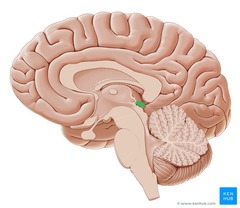
<p>This gland sits just posterior to the thalamus and directly superior to the superior colliculus. </p><p>An important endocrine gland that secretes melatonin. This hormone is responsible for the regulation of our circadian rhythm (light-dark cycle).</p>
9
New cards

Gonads

Testes in males and ovaries in females.

<p>Testes in males and ovaries in females.</p>
10
New cards

Ovary

Different structures secrete different hormones based on the timing of the ovarian cycle. While the follicle is primarily responsible for secreting estrogen, the corpus luteum primarily secretes progesterone.

<p>Different structures secrete different hormones based on the timing of the ovarian cycle. While the follicle is primarily responsible for secreting estrogen, the corpus luteum primarily secretes progesterone.</p>
11
New cards

Testis

Within the testes, the interstitial cells in between the seminiferous tubules secrete testosterone. Testosterone is necessary for proper sperm development and leads to the secondary male sex characteristics (ex. increasing the size of the thyroid cartilage to create the "Adam's apple", or laryngeal prominence).

<p>Within the testes, the interstitial cells in between the seminiferous tubules secrete testosterone. Testosterone is necessary for proper sperm development and leads to the secondary male sex characteristics (ex. increasing the size of the thyroid cartilage to create the "Adam's apple", or laryngeal prominence).</p>
12
New cards

Pancreas

A gland with both exocrine and endocrine functions. The exocrine tissue of the pancreas, the acinar tissue.

These pancreatic juices are secreted through ducts directly into the duodenum. The pancreatic islets are the areas of the pancreas that have an endocrine function in maintaining the blood sugar level.

<p>A gland with both exocrine and endocrine functions. The exocrine tissue of the pancreas, the acinar tissue.</p><p>These pancreatic juices are secreted through ducts directly into the duodenum. The pancreatic islets are the areas of the pancreas that have an endocrine function in maintaining the blood sugar level.</p>
13
New cards

Parathyroid gland

Closely associated with the thyroid gland. They are located on the posterior aspect of the thyroid and are important in maintaining calcium concentration in the blood.

<p>Closely associated with the thyroid gland. They are located on the posterior aspect of the thyroid and are important in maintaining calcium concentration in the blood.</p>
14
New cards

Thymus gland

This gland often gets dissected off of the cadavers due to its small size and proximity to the soft tissue and fat just deep to the sternum. However, it's much bigger during childhood. Hormones released work within the lymphatic system to ensure the maturation of T cells, which are important in fighting infection.

<p>This gland often gets dissected off of the cadavers due to its small size and proximity to the soft tissue and fat just deep to the sternum. However, it's much bigger during childhood. Hormones released work within the lymphatic system to ensure the maturation of T cells, which are important in fighting infection.</p>
15
New cards

Thyroid gland

A butterfly-shaped endocrine gland in the neck that produces hormones to regulate metabolism, growth, and body functions like heart rate and temperature.

<p>A butterfly-shaped endocrine gland in the neck that produces hormones to regulate metabolism, growth, and body functions like heart rate and temperature.</p>
16
New cards

Estrogen (E2)

produced by developing follicles

produced in female gonad

<p>produced by developing follicles</p><p>produced in female gonad</p>
17
New cards

Progesterone (P4)

maintains pregnancy, produced by the corpus luteum on the ovary

produced in female gonad

<p>maintains pregnancy, produced by the corpus luteum on the ovary</p><p>produced in female gonad</p>
18
New cards

Testosterone (T)

Secretes by the interstitial cells in between the seminiferous tubules.

necessary for proper sperm development and leads to the secondary male sex characteristics (ex. increasing the size of the thyroid cartilage to create the "Adam's apple", or laryngeal prominence).

produced in male gonads

<p>Secretes by the interstitial cells in between the seminiferous tubules. </p><p>necessary for proper sperm development and leads to the secondary male sex characteristics (ex. increasing the size of the thyroid cartilage to create the "Adam's apple", or laryngeal prominence).</p><p>produced in male gonads</p>
19
New cards

Hypothalamic-Pituitary-Thyroid Axis

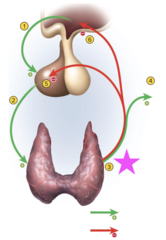
A neuroendocrine system that regulates metabolism, consisting of the hypothalamus, pituitary gland, and thyroid gland. When thyroid hormone levels drop, the hypothalamus releases thyrotropin-releasing hormone (TRH), which prompts the pituitary to release thyroid-stimulating hormone (TSH). TSH then signals the thyroid to produce and release thyroid hormones (T3 and T4), which boost metabolism. These hormones then provide negative feedback to the hypothalamus and pituitary, slowing down TRH and TSH production to maintain balance.

<p>A neuroendocrine system that regulates metabolism, consisting of the hypothalamus, pituitary gland, and thyroid gland. When thyroid hormone levels drop, the hypothalamus releases thyrotropin-releasing hormone (TRH), which prompts the pituitary to release thyroid-stimulating hormone (TSH). TSH then signals the thyroid to produce and release thyroid hormones (T3 and T4), which boost metabolism. These hormones then provide negative feedback to the hypothalamus and pituitary, slowing down TRH and TSH production to maintain balance.</p>
20
New cards

Thyrotropin-releasing hormone (TRH)

A hormone produced in the hypothalamus that primarily stimulates the pituitary gland to release thyroid-stimulating hormone (TSH)

<p>A hormone produced in the hypothalamus that primarily stimulates the pituitary gland to release thyroid-stimulating hormone (TSH)</p>
21
New cards

Thyroid-stimulating hormone (TSH)

A hormone that your pituitary gland releases to trigger your thyroid to produce and release its own hormones — thyroxine (T4) and triiodothyronine (T3).

<p>A hormone that your pituitary gland releases to trigger your thyroid to produce and release its own hormones — thyroxine (T4) and triiodothyronine (T3).</p>
22
New cards

Thyroxine (T4)

A hormone produced by the thyroid gland that regulates metabolism, with a key role in heart rate, body temperature, and growth. It is released into the blood and converted to the more active hormone triiodothyronine (T3) in the body's tissues.

<p>A hormone produced by the thyroid gland that regulates metabolism, with a key role in heart rate, body temperature, and growth. It is released into the blood and converted to the more active hormone triiodothyronine (T3) in the body's tissues.</p>
23
New cards

Triiodothyronine (T3)

A thyroid hormone that regulates metabolism, heart rate, body temperature, and growth. While the thyroid gland produces some, most is created in other body tissues by converting the inactive hormone thyroxine (T4) into the active form.
<p>A thyroid hormone that regulates metabolism, heart rate, body temperature, and growth. While the thyroid gland produces some, most is created in other body tissues by converting the inactive hormone thyroxine (T4) into the active form.</p>
24
New cards

Glucagon

The pancreatic islets secrete hormones that control the blood sugar levels. When blood glucose is too low, this hormone signals the liver to break down stored glycogen and release it into the blood, raising BG.

<p>The pancreatic islets secrete hormones that control the blood sugar levels. When blood glucose is too low, this hormone signals the liver to break down stored glycogen and release it into the blood, raising BG.</p>
25
New cards

Insulin

The pancreatic islets secrete hormones that control the blood sugar levels. When blood glucose is too high, this hormone signals the liver to remove glucose from the blood and store it as glycogen, decreasing BG.

<p>The pancreatic islets secrete hormones that control the blood sugar levels. When blood glucose is too high, this hormone signals the liver to remove glucose from the blood and store it as glycogen, decreasing BG.</p>
26
New cards

Hypersecretion

When a gland produces too much hormone.

27
New cards

Hyposecretion

When a gland produces too little hormone.

28
New cards

Thyroid conditions

Hyperthyroidism and hypothyroidism, as well as thyroid nodules. Common causes are autoimmune diseases like Graves' disease and Hashimoto's disease, inflammation, or damage from radiation or surgery. Symptoms vary depending on the condition and can include weight changes, fatigue, heart rate changes, and mood alterations.

<p>Hyperthyroidism and hypothyroidism, as well as thyroid nodules. Common causes are autoimmune diseases like Graves' disease and Hashimoto's disease, inflammation, or damage from radiation or surgery. Symptoms vary depending on the condition and can include weight changes, fatigue, heart rate changes, and mood alterations.</p>
29
New cards

Graves' disease

An autoimmune disorder that causes an overactive thyroid hyperthyroidism leading to symptoms like weight loss, rapid heartbeat, and anxiety. Treatments include antithyroid drugs, radioactive iodine therapy, or surgery to remove the thyroid. In some cases, it can also affect the eyes and skin.

<p>An autoimmune disorder that causes an overactive thyroid hyperthyroidism leading to symptoms like weight loss, rapid heartbeat, and anxiety. Treatments include antithyroid drugs, radioactive iodine therapy, or surgery to remove the thyroid. In some cases, it can also affect the eyes and skin.</p>
30
New cards

Hashimoto's disease

An autoimmune disorder where the immune system attacks the thyroid gland, leading to hypothyroidism and a decrease in thyroid hormone production. Symptoms develop slowly and can include fatigue, weight gain, cold sensitivity, and dry skin, although some may experience no symptoms for a long time. It is managed with lifelong thyroid hormone replacement therapy, usually with the medication levothyroxine.
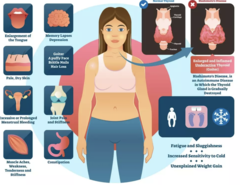
<p>An autoimmune disorder where the immune system attacks the thyroid gland, leading to hypothyroidism and a decrease in thyroid hormone production. Symptoms develop slowly and can include fatigue, weight gain, cold sensitivity, and dry skin, although some may experience no symptoms for a long time. It is managed with lifelong thyroid hormone replacement therapy, usually with the medication levothyroxine.</p>
31
New cards

Primary hypothyroidism / Iodine deficiency

Iodine deficiency is a leading cause of a condition where the thyroid gland doesn't produce enough thyroid hormones. Without sufficient iodine, the thyroid gland cannot synthesize its hormones, leading to symptoms like fatigue, weight gain, cold intolerance, and a swollen neck (goiter)

<p>Iodine deficiency is a leading cause of a condition where the thyroid gland doesn't produce enough thyroid hormones. Without sufficient iodine, the thyroid gland cannot synthesize its hormones, leading to symptoms like fatigue, weight gain, cold intolerance, and a swollen neck (goiter)</p>
32
New cards

TRH-secreting tumor

Tumor causing overproduction of TRH.

High TRH

High TSH

High T4 and T3

Hyperthyroidism
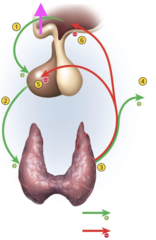
<p>Tumor causing overproduction of TRH. </p><p>High TRH</p><p>High TSH</p><p>High T4 and T3</p><p>Hyperthyroidism</p>
33
New cards

TRH-suppressing tumor

Tumor causing underproduction of TRH.

Low TRH

Low TSH

Low T4 and T3

Hypothyroidism

<p>Tumor causing underproduction of TRH. </p><p>Low TRH</p><p>Low TSH</p><p>Low T4 and T3 </p><p>Hypothyroidism</p>
34
New cards

TSH-secreting tumor

Tumor causing overproduction of TSH.

Low TRH

High TSH

High T3 and T4

Hyperthyroidism
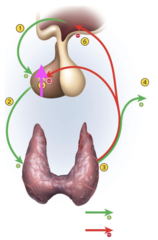
<p>Tumor causing overproduction of TSH. </p><p>Low TRH</p><p>High TSH</p><p>High T3 and T4</p><p>Hyperthyroidism</p>
35
New cards

TSH-suppressing tumor

Tumor causing underproduction of TSH.

High TRH

Low TSH

Low T3 and T4

Hypothyroidism

<p>Tumor causing underproduction of TSH.</p><p>High TRH </p><p>Low TSH </p><p>Low T3 and T4 </p><p>Hypothyroidism</p>



