Ex 2 FF2
 Call Kai
 Learn
 Practice Test
 Spaced Repetition
 Match
 Flashcards
 Knowt Play
1/74

There's no tags or description
Looks like no tags are added yet.
75 Terms
Olfactory receptor cells are located within ______
olfactory epithelium
CN I is located/passes trough ____
foramina of the cribiform plate
How do you test CN I
Offer yummy trests to see if they trace scent
Function of the Cilia/olfactory cells of the dendrites of olfactory receptor cells
trap/bind odorant molecules
CN II begins at the ______
optic disk
Most fibers of optic nerve go to ________ of the thalamus
lateral geniculate nucleus
CN II pass. trough ______ holes in the conective tissue in order to recieve information from the eye
area cribrosa
Area cribrosa can pinch axons and cause _____
blindness
Can happen due to high IOP (Glaucoma)
How you test CN II
Move hand in menacing manner, without pushing air into eye, or drop cotton ball in front of eye
CNs supplying the extraocular muscles
III, IV, VI
CN III in charge of ______ movement of eye
medial, dorsal, and ventral (y ventral oblique)
CN IV (trochlear) function
Rotation of eye (dorsal oblique m.)
CN VI (Abducens) function
Lateral movement of eye, retract eye into orbit
In Development there are _______ from here arises a nerve, bone/cartilage, muscle and an artery
pharyngeal arches (1, 2, 3, 4, 6)
Pharyngeal arch 1 give rise to
CN V V3, Muscles of mastication
Pharyngeal arch 2 give rise to
Muscles of facial expression, CN VII
Pharyngeal arch 3 give rise to
CN IX, Caudal Tounge taste /Pharynx area
Pharyngeal arch 4 give rise to
CN X, Caudal tounge, Larynx
Pharyngeal arch 6 give rise to
CN X, Larynx
Rostral belly of Digastricus m is innervated by the ____ and the caudal belly by ____
mandibular n (CN V V3), Facial n (CN VII)
Tongue originates form arches ___ -____
1-4
The tongue recieves Nerve supply from CNs: ____
V, VII, IX, X
CN V V1 (Ophtalmic) function
Sensory innervation to eyelids, forehead, scalp, eyes, horn in ruminants
CN V V2 (Maxillary) function
Sensory innervation to gums, nasal mucosa, lips, upper teeth
CN V V3 (Mandibular) function
Sensory for ear, face, cheek, tongue, lower teeth
Motor for muscles of mastication
Three main branches that come off CN V V1:
Nasociliary
Frontal
Lacrimal
Frontal n., Branch of CN V V1, provides sensory innervation to ____ canthus o feye
lateral
Infratrochlear n., branch of CN V V1, provides sensory innervation to _____ cathus of eye
medial
Cutaneous innervation of Trigeminal n. (CN V V1) (branches)
frontal n
Infratrochlear n.
Three mayor branches of the CN V V2 (Maxillary n.)
Zygomatic n
Infraorbital n
Pterygopalatine n
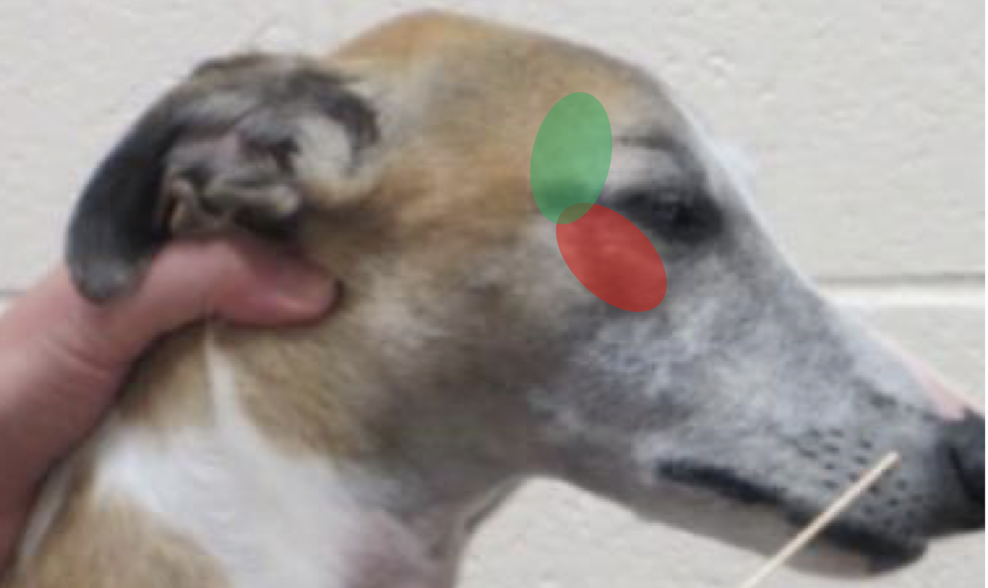
The red circle is the ____ branch of the zygomatic n.
Zygomaticofacial n
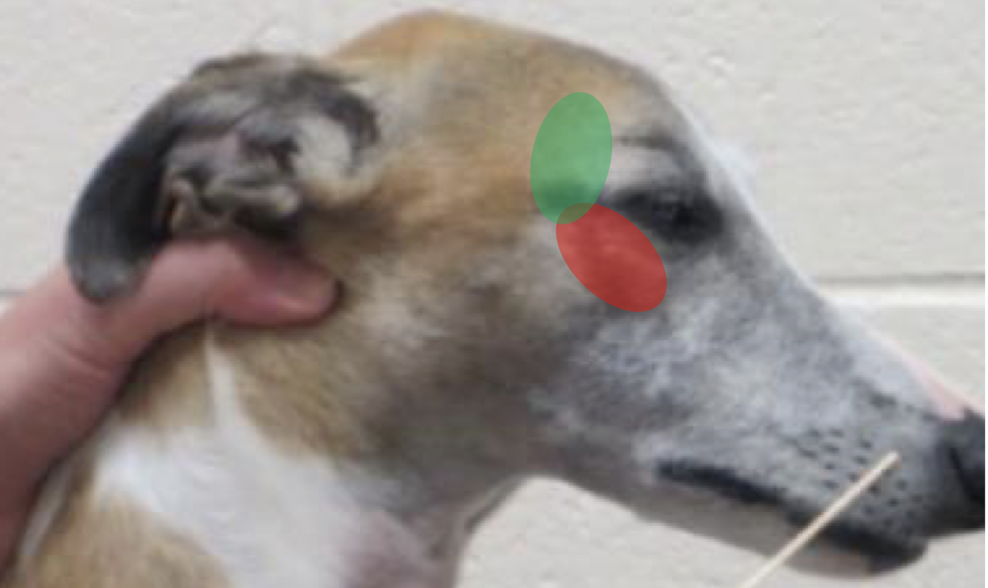
the green circle is the ____ brach of the zygomatic n.
zygomaticotemporal n.
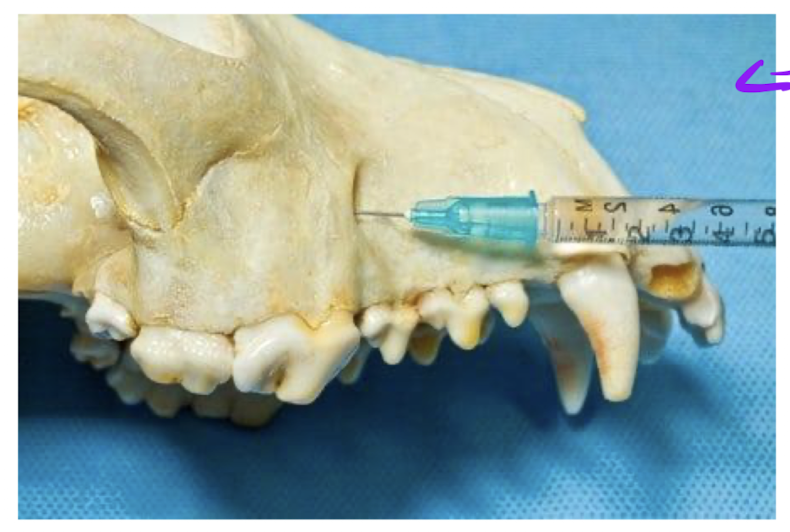
what nerve is being blocked here
infraorbital n. (passing through the infraorbital foramen)
cutaneous innervation of the maxillary n. (CN V V2)
Infraorbital
Zygomaticotemporal
Zygomatico facial
What test can we do to test for CNV 1-2 (maxillary and opthlamic divisions)
Palpebral reflex and Vibrissae response
Sensory branches of the Mandibular n. (CN V V3)
B uccal
L ingual
I nferior Alveolar
M ental
A uriculotemporal

what nerve innervates this area
Mandibular n. (CN V V3)

What nerve I am blocking here
Mental nerve
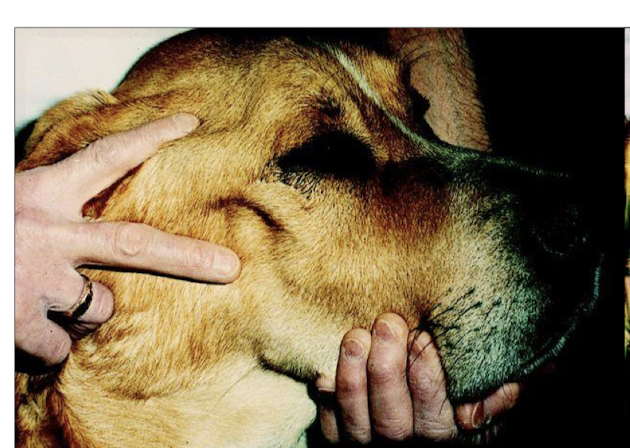
Atrophy/Wasting in Masseter and temporalis mm. and Zygomatic arch prominence are signs of ______ nerve damage
Madibular (CN V V3)
CN VII (Facial n.) provides ________ innervation to glands
parasympathetic
Branches of the facial n. (CN VII)
Major petrosal
Chorda tympani (secretomotor)
Chorda tympani (sensory)
Chorda tympani recieves ______ information from ____ 2/3 of tongue
chemical sensory, rostral
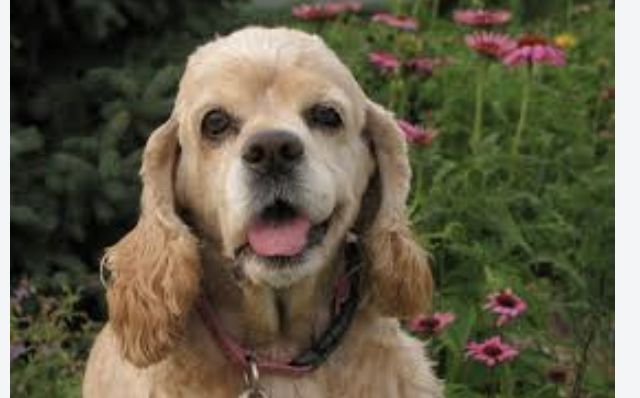
What nerve is damaged in dog
Facial n (CN VII)
CN IX (Glossopharyngeal n.) Lingual branch carry special ____ sensation form caudal ____ of the tongue to brain
taste, 1/3
CN X (vagus n.) innervates muscles of ____ & _____
larynx & pharynx
The “gag reflex” is due to ____ & ______ CNs
IX, X
CN in charge of motor innervation for the tongue
CN XII

What CN is damaged here
CN XII (Hypoglossal n)
Hypoglossal nerve paralysis
Muscle in charge of narrowing eyes and '“blinking” motion
Orbicularis oculi m.
Muscle in charge of dilating nostrils and elevating lip
levator nasolabialis m.
kissing muscle
orbicularis oris m.
Muscles in charge of closing jaw
Temporalis m.
Massester m.
Pterygoid m. (lateral and medial)
What nerve innervates mucles in charge of closing jaw
Mandibular n. (CN V V3)
Muscle in charge of opening mouth
Digastricus m.
What nerves innervate Digastricus m.
Mandibular (rostral)
Facial (caudal)
Muscles of the Ear
Rostral auricular mm
Caudal auricular mm
Muscle in charge of swallowing
Crycopharyngeous m.
In what part of the eye can we see insertions of the extrinsic ocular muscles
Sclera
What type of tissue has the sclera
dense irregular connective tissue
the iris arises form the ______ of vascular tunic
ciliary body
The dilator pupillae m. and sphincter pupillae muscles are found in the ______ of the eye
Iris
What term is used to describe the constriction of pupil
Miosis
What term is used to describe the Dilation of pupil
Mydriasis
Ciliary body produces the _____ in the ____ chamber of the eye
aqueous humor, posterior
Structures that suspend lens to the ciliary body are called _____ fibers
Zonular
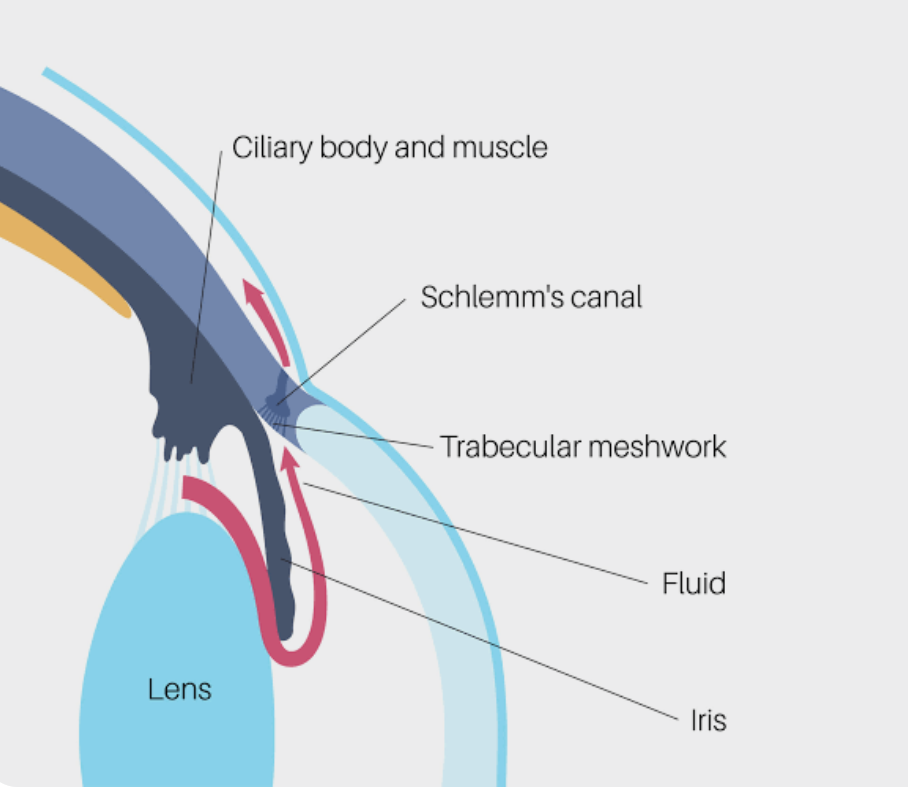
The aqueous humor drains through the ____
trabecular meshwork
The tapetum lucidum is a modification of the _____ in mammals
Choroid of the vascular tunic
What cells in the retina are photoreceptors
Rods: function best in darkness, can synapsy with several bipolar cells
Cones: function best in light, synapses with a single bipolar neuron
(T o F) Dettachments in the retina are commonly from the layer of rods and cones
T
The nerve that innervates the retina is
CN II (Optic n.)
Ganglion cell axons converge at the ______ to form the ____
optic disc, optic nerve (CN II)
Blood vessels that supply the choroid come out of the _____
optic disc
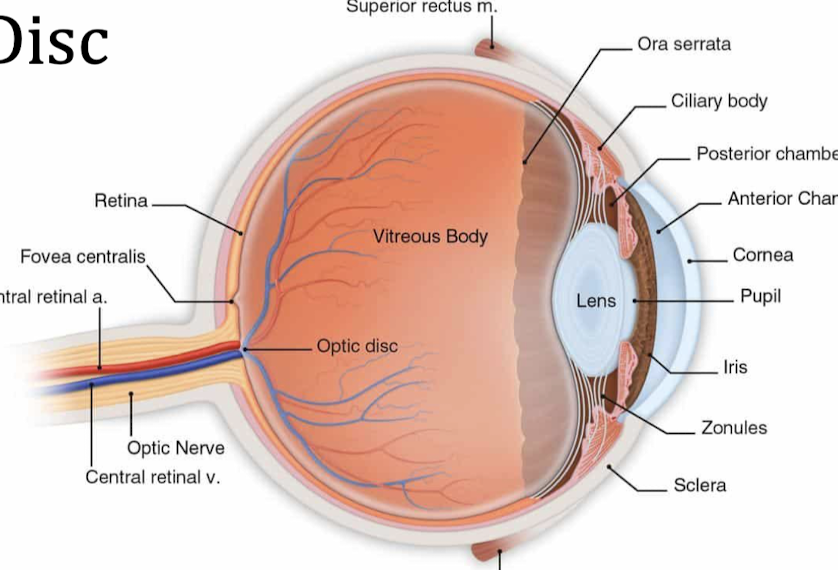
Name of muscle that dilates the pharynx
Stylopharyngeus
Muscles in charge of contriction of Pharynx
Cricopharyngeus: Caudal pharynx
Thyropharyngeus: middle pharynx
Hyiopharyngeus: rostral pharynx
Nerves innervating the pharynx
CN X (Vagus n) & CN IX (Glossopharyngeal n.)