Investigating the Equine Upper Airway
 Call Kai
 Learn
 Practice Test
 Spaced Repetition
 Match
 Flashcards
 Knowt Play
1/33

There's no tags or description
Looks like no tags are added yet.
34 Terms
Describe the general structure and function of the Equine URT?
• Horse is an obligate nasal breather
• Athletic function requires low resistance, high capacity passage for air
• Disease or dysfunction has a major impact on athletic function
Seal between soft palate and larynx vital to:-
Prevent aspiration of food material
Prevent interference with airway
Provided by:
•epiglottis and aryepiglottic fold
•arytenoids
•soft palate

Describe the normal Resp. rate of the equine.
Rest
• Resp rate
12 - 16 bpm
• Tidal Volume
5 litres
• Minute ventilation
80 litres/min
Exercise
• Resp rate
140-150bpm
• Tidal Volume
10 - 12 litres
• Minute ventilation
1700 litres/min
What factors contribute to the equine’s successful athletic performance?
• Large aerobic capacity
• Ability to sustain maximal or near maximal speeds
> 70% energy supplied aerobically in a 1000 m sprint
• Rapid O2 kinetics
• Also large anaerobic capacity
Why does disease affecting the upper airway result in poor performance?
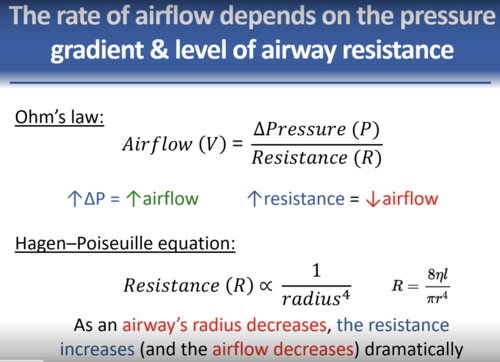
• 80-90% of airway resistance is from upper airways
• Changes during inhalation and exhalation
2/3 of airflow resistance in the upper airway
• During exercise upper airway resistance increases by 80%
• If the diameter reduces by 20%, airway resistance doubles
• Airway impedance R
What are the clinical signs of URT disease in horses?
• Asymptomatic
• Respiratory Noise with or without exercise intolerance
Noise occurring during inspiration and expiration, evident at rest
Noise occurring during inspiration and expiration, only evident at exercise
Noise occurring during only inspiration at exercise
• Dysphagia, nasal reflux of food material, and/or cough
Figure out if horse actually has poor performance or does the horse not have the capabilities of what the owner wants it to do
How does gait affect respiration in horses?
• At gallop, stride rate and respiratory rate are coupled
• Therefore, the clinician can recognize inspiration (flight phase) and expiration (limbs striking the ground)
Inspiration (Horses limbs in air)
Expiration (Limbs strike ground, viscera hits diaphragm to help expel air)
• At the trot, breathing and stride rate are independent = not coupled
What is the number one causes of poor horse performance?
Lameness
When investigating respiratory disease in equines, you should rule out other diseases by performing:
• Full clinical examination
Rule out lameness, cardiac disease etc
• Lunge
— Both directions - determine if inspiratory or expiratory
• Exercise test
• Endoscopy
• Rebreathing
How do we perform a resting endoscopy?
Always look in a resting, non-sedated horse as sedation can make issues look worse or dynamic abnormalities may be changed
• Restraint - twitch, stocks, be calm, wear a helmet
• Resting
• Nasal Occlusion
can make them take a big breath
• Post exercise
• Overground endoscopy
How do we perform overground Endoscopy?
Endoscopy which can be used while horse is exercising, Many upper airway disorders in horses do not appear when the horse is standing quietly. They only happen during high-intensity exercise under fatigue or heavy breathing. Allows dynamic examination.
• Unique scope design - industrial boroscope, can be twisted around and manipulated
• Attaches to bridle
• Wireless pictures
• Real time examination
Key questions to ask about URT concerns in Equines?
Is there a noise?
When is the noise?
Is there poor performance?
Are there changes on endoscopy at rest?
What is expected of the horse?
Does owner want them to win a race, ride for pleasure, dressage?
What are the main features of pharyngeal lymphoid hyperplasia?
Pharyngeal lymphoid hyperplasia (PLH) is a common, normal immune response in young horses (typically 1 to 3 years old) characterized by small, raised bumps or follicles on the dorsal and lateral walls of the pharynx.
• Combination of immune response and exposure to infection
Can make rough noise, a bit more mucus
• Occurs in young horses
• Usually incidental finding
• If severe, rest and anti- inflammatories
What are the main features of Epiglottic entrapment?
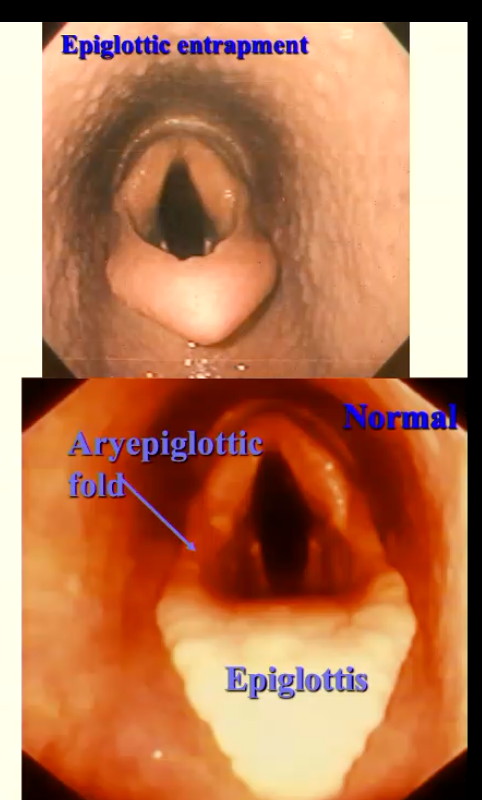
Epiglottic entrapment happens when a fold of mucous membrane (the aryepiglottic fold) stretches over and completely surrounds the epiglottis (the triangular cartilage flap at the base of the throat). Can cause some respiratory noise and poor performance.
• Aryepiglottic folds: bands of mucosa that attach along the free edge of the epiglottis
• Ventrally mucosa is loosely attached and can become displaced above epiglottis
The entrapment: Instead of sitting normally underneath or beside the cartilage, this loose fold of tissue flips upward and envelops the apex (tip) and lateral margins of the epiglottis—like a hood or a sock pulled over it.
• Aetiology unknown
• Usually assymptomatic but clinical signs include respiratory noise and coughing
• Diagnosis on endoscopy - loss of normal irregular margin of epiglottis (Scalloped leaf pattern) and vascular pattern
What are the main two diseases of the equine upper airways?
• Idiopathic Laryngeal neuropathy (laryngeal paralysis)
• Everything else
Describe the main features of laryngeal neuropathy.
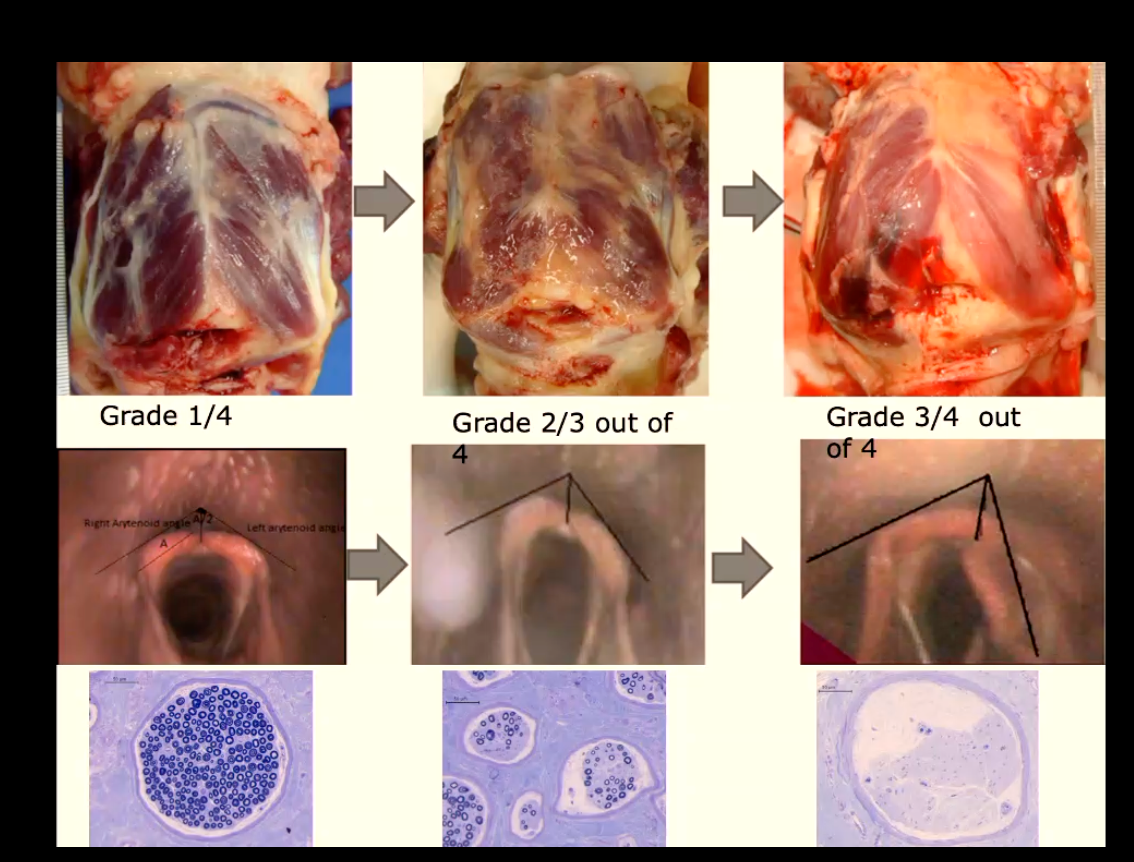
Results in unilateral paralysis of arytenoids, caused by neurogenic atrophy of muscles of abduction esp. cricoarytenoid dorsalis muscle, is a progressive, acquired degenerative nerve disease
Progressive loss of large myelinated fibres
Damage / dysfunction of recurrent laryngeal nerve (branch of vagus)
Muscle fibers lost due to lack of innervation and use, struggles to cope with exercise
An ancient disease
What are the different types of laryngeal neuropathy?
Idiopathic form affects left side
Overwhelming evidence suggests that this is a genetic disease which is present in every horse - but need 75% of nerve damaged to see clinical signs, many horses do not lose this much
Progressive in 10% of cases
Overt disease affects around 2.5% of performance horses
Trauma to nerve - second cause which can cause this disease as well
• Perivascular injection
• Swelling in the neck
Toxicity/ organophosphates
Hepatic encephalopathy(bilateral)
How is laryngeal neuropathy diagnosed?
Characteristic roaring/whistling noise at exercise
Degree of exercise intolerance variable,
• depends on owners expectation of horse
• Hunters & hacks - owner notices more than horse
• Racehorses & high performance sports horse - may limit athletic capability
Palpable muscle atrophy - not reliable
Absent slap test - pointless test, not diagnostic
Endoscopy/overground endoscopy - gold standard
Describe the grading system used for laryngeal grading?
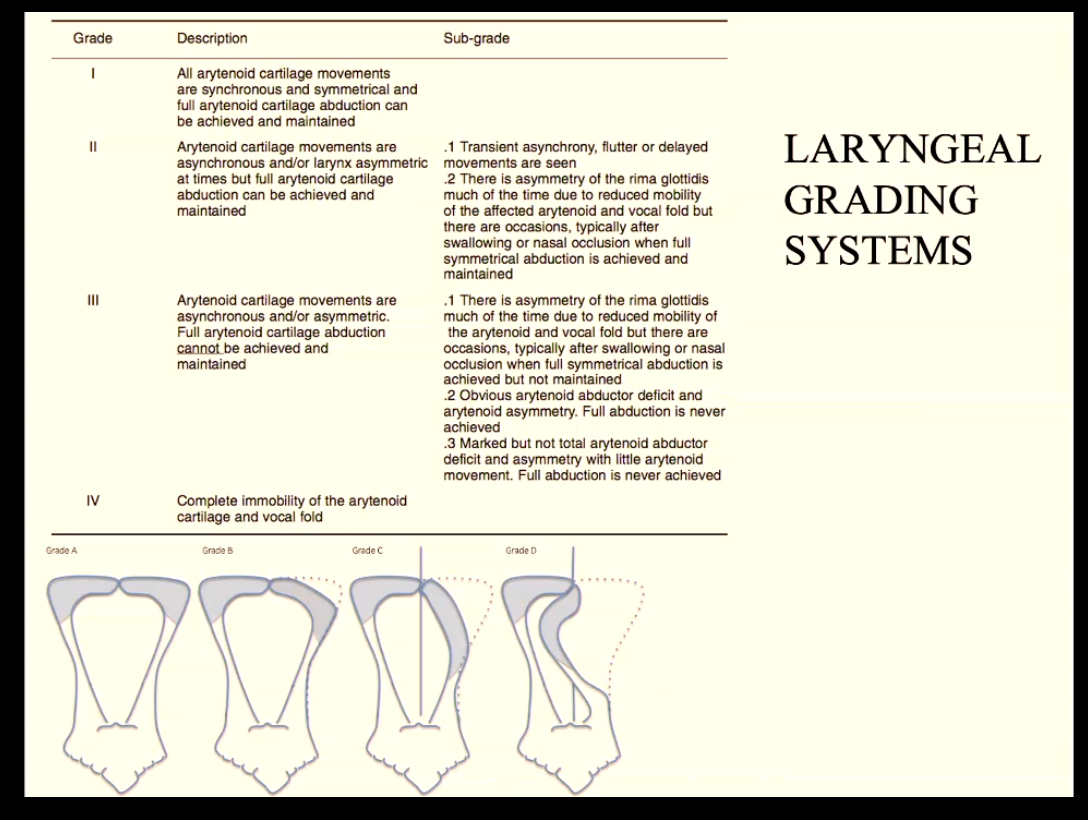
Grades function rather than dysfunction
Grade I - normal
Grade II - can achieve full abduction but cannot maintain it
Grade III - cannot achieve full abduction
Grade IV - cannot move airway at all
What are the main treatment options for laryngeal neuropathy?
Laryngoplasty Prosthetic Laryngoplasty (tie back)
• Aim: to permanently hold the arytenoid in an abducted position (Want to see around 75% so they can still close to protect airway but it is open enough)
• Most popular in horses where poor performance is present
• Complications: dysphagia, tracheitis, infection of implant
Ventriculectomy (Hobday)
Laryngotomy incision - removes the lateral ventricle and vocal fold of the larynx in horses
Heals by 2nd intention
Usually combined with cordectomy (Removal of vocal chords)
Removing the ventricles alone only noise, so combined with chordectomy (ventroculochordectomy)
Only stabilizing arytenoids will help with performance hower
Can do with LASER
Vocalcordectomy
Arytenoidectomy
Laryngeal re-innervation
Branches of the first cervical nerve (C1) and the spinal accessory nerve are implanted into the paralysed CAD muscle
Reinnervation takes 6-9 months
Training speeds reinnervation - more communication between muscle and nerve
Success rates are high
The surgery is technically demanding and only offered in a small number of centres
Recently a combination of the tieback and nerve grafting has been described (the Dynamic Neuroprosthesis (DNP), this is the future!
What are complications associated with surgery used to correct laryngeal neuropathy?
Complications include dysphagia and aspiration pneumonia
Coughing
Persistent noise
Failure to restore function
Infection
Can be disasterous
When is nerve grafting a suitable option?
Need horse to have muscles (Cannot do grade 4)
Screen horses early on
Describe how emergency tracheostomies are performed?
Same procedure in all animals - animals present with respiratory noise, cyanosis, unstable
1. Junction of middle and upper third of neck
2. Infiltrate local anaesthetic -if possible
3. Longitudinal, vertical incision through skin
4. Divide strap muscles (blunt)
5. Identify trachea
6. Make a horizontal incision between the tracheal cartilages
Describe the two conditions involved in displacement of the soft palate in equines.
Two distinct conditions
• Permanent displacement of the palate
Intermittent dorsal displacement of the palate
Describe permanent dorsal displacement of the soft palate.
• Secondary to neurological damage,
e.g. guttural pouch disease, neoplasia, peripheral neuropathies
• Causes major exercise intolerance and dysphagia
• Poor prognosis
Describe intermitent dorsal displacement of the soft palate (IDDSP).
• Around 50% of horse make characteristic noise
• Multiple described aetiologies and treatments, ultimately leads to expiratory obstruction
Young performance horses effected, less commonly pleasure horses
• Occurs at high speed
Diagnois
• Characteristic history
• Sudden impairment in performance, often at maxima exercise in "good" horses
Open mouth breathing
• Fluttering of the cheeks
• Gurgling, chocking expiratory noise
• Resting endoscopy, treadmill endoscopy
• Many normal horses will displace their palates during endoscopy therefore identification at rest is of questionable significance
• Overground endoscopy is the gold-standard for diagnosis
What is the mechanism by which IDDSP occurs?
Muscle Fatigue: Electromyographic (EMG) studies show that the thyrohyoideus muscles (which pull the larynx forward and the basihyoid caudally to maintain proper overlap) undergo clear muscle fatigue during peak exercise intensity in affected horses.
Neuromuscular Dysfunction: The stability of the soft palate relies on coordinated motor control. Dysfunction of the pharyngeal branch of the vagus nerve leads to loss of tone and palatal instability.
What is the pathogenesis of IDDSP?
- 50% of cases have concurrent lower airway disease
- Concurrent disease (epiglottic entrapment)
- Some horses will do this while unfit, with resolution as fitness increases
- Hypoplastic or flaccid epiglottis?
- Long soft palate?
- Primary Neurological disease
What nerves innervate the palate?
- innervation includes trigeminal, pharyngeal branch of the vagus and glossopharyngeal nerves and recent work suggests that neuropathies associated with respiratory infections may have role in DDSP
Neuritis of nerves due to inflammation throughout airway
Airway - flaccid and displaces palates
Sometimes when lower respiratory tract heals, the palate displacement resolves
How is IDDSP managed?
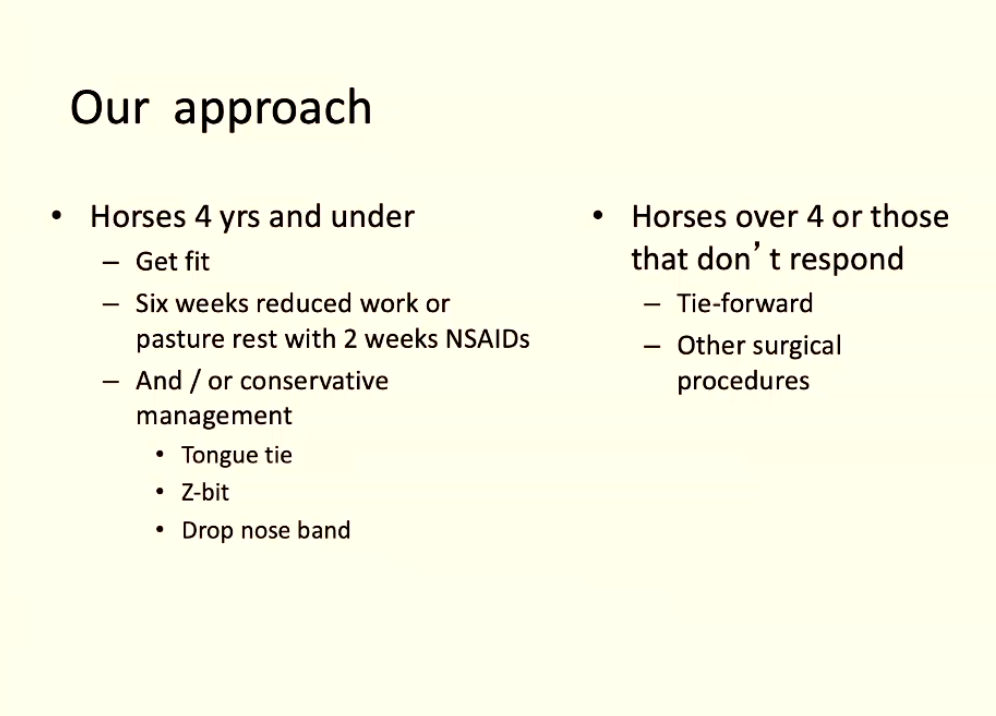
Conservative management for young horses
Laryngeal tie-forward

How does age guide treatment for IDDSP?
The Goal: The surgery permanently repositions and stabilizes the larynx so it cannot slip backward out of position.
The Technique: Surgeons place permanent sutures (prostheses) between the thyroid cartilage of the larynx and the basihyoid bone (hyoid apparatus) at the base of the tongue.
The Effect: This pulls the larynx forward and upward, increasing the overlap between the epiglottis and the soft palate. This mechanical lock prevents the soft palate from flipping up into the airway.
70-90% success rate
How does tracheal collapse present?
• Congenital defect that is most often seen in minature horses
Makes a honking noise, prevent excitement
• Often these ponies can have a normal quality of life
What are the main features of arytenoid chondropathy?
• Progressive inflammatory chondritis, may be associated with granulomas and discharging tracts
Cartilage has poor blood supply, getting on top of infection is very difficult
• May respond to antibiotics, many require surgical excision of the arytenoid
If you remove to much - predispose to dysphagia
Describe the main features of masses and cysts associated with the pharynx.
• Soft tissue masses may be:
- congenital palatal or pharyngeal cysts
- granulomas (fungal or bacterial)
- neoplasia (lymphosarcoma or squamous cell carcinoma)
• Surgical management will depend on specific site and nature of mass
Horses often get foreign bodies in the upper airways which can be identified by?
Identified by endoscopy and history of cough and mild colic signs
options include removal by endoscopy per nasum (standing), or manually via mouth or laryngotomy