Earth system questions
 Call Kai
 Learn
 Practice Test
 Spaced Repetition
 Match
 Flashcards
 Knowt Play
1/61

There's no tags or description
Looks like no tags are added yet.
62 Terms
What is the difference between weather and climate?
Weather is the atmospheric state in near-future, based on the state now (initial conditions). Climate is the long-term trend in how the atmospheric state will evolve using boundary conditions.
Which positive and negative climate feedbacks exist?
Positive:
Ice-albedo
Water vapor
Lapse rate at high latitudes
Permafrost carbon feedback
Fire feedback- increased temperatures –> more drought-> more fires with release of CO2 and CH4-> warmer temperatures
Cloud feedbacks (high clouds)
Aerosol-cloud interaction: increases the reflectivity of the clouds due to increased aerosol particles, which increases the droplet amount and decreases the size of each droplet
Ocean current ice sheet instability feedback
Negative:
Planck-feedback (Stefan-Boltzmanns T^4 black-body law. Radiation ~ T^4)
Lapse rate in the tropics
CO2-fertilization : increases plant growth and uptake of CO2
Cloud feedbacks
Low clouds
Which model resolution is available in AR6?
Horizontal: 1 - 2 degrees, 30-90 vertical layers with more layers close to the surface
What is CMIP and which CMIPs exist for IPCC AR6?
Coupled Model Intercomparison Project is a project combining multiple ESMs and all are required to do the same DECK-experiments (ssp, historic etc.) to be comparable to each other.
CMIP 6, CMIP5 (unpublished) and CMIP3 (historical) are all used in the AR6
What is a Shared Socioeconomic Pathways (SSP) scenario?
Possible futures, depending on how we as humans act for the climate
What is a climate forcing, response, feedback, sensitivity, equilibrium?
Climate forcing: A change (external forcing) in the radiative balance in the energy budget of the Earth
Climate response: The earth systems’ reaction to a climate forcing
Climate feedback: A process which changes the climate from an initial forcing
Climate sensitivity: Defined as the warming resulting from a doubling of CO2-concentration
Climate equilibrium: When the climate system has reached balance
How do you expect the albedo to change through ice melt? Deforestation?
Ice melt → Decrease in albedo
Deforestation → Increase in albedo. Since trees often have a lower albedo than the ground, but it really depends on the surface. Also, without trees, the snow can stay longer on the surface, which can actually increase the albedo even more.
Why is so much excess energy stored in the ocean?
The ocean has a large heat capacity, which makes so that it can hold a lot of heat.
What can lead to radiative imbalance?
Solar cycles
Emission of gases and aerosols, subsequent chemical reactions modifying ozone and aerosols amount
Changing cloud properties affecting the radiative budget
Changes in vegetation or in land- surface properties, changing the albedo
What is the MOC?
Meridional Overturning Circulation, it is how water-masses are transported in the north-south direction.
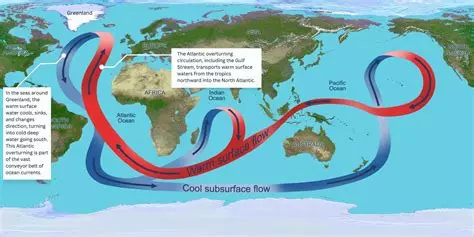
What is driving the MOC?
What is driving MOC is differences in buoyancy (salinity and temperature), winds (geostrophic winds)
What are the subtropical gyres? How are they driven?
These are ocean currents that are constrained by land masses, and are driven by the westerlies and the trade winds, which make them circulate clockwise in the northern hemisphere, and counterclockwise in the southern hemisphere.
What is the AMOC; is it different from the Gulf Stream? Will they shut down?
Atlantic Meridional Overturning Circulation is how the water is transported in the Atlantic Ocean. The gulf stream is just the high-velocity current moving north-east from America up to Europe. They willl not reach a point of shut down, but will cease in strength, according to the IPCC-report.
Which role does the ocean heat uptake play for the Energy Inventory; how is it changing over time?
The ocean is storing about 91% of the heat, while the atmosphere is 1%. This can maybe change over time, as the ocean comes to a balance, and can take up less heat.
How are Salinity and E- P connected? How are they changing?
Salinity is connected to Evaporation and Precipitation, since these are sources and sinks of salinity. Evaporation from the ocean, leaves more salt left in the ocean, which increases the salinity. Precipitation does the opposite.
Why is polar amplification stronger in the NH?
Land areas are warming more
No strong winds currents blocking warming
Sea ice melting faster
50% snow coverage on land -> declining
What is the difference between GMST and GSAT?
GMST : global mean surface temperature. Estimated global average of near-surface (2m) air temperatures over land and sea-ice, and sea surface temperatures over ice-free ocean regions.
GSAT : global surface air temperature. Global average of near-surface (2m) air temperatures over land and oceans. Changes in GSAT are often used as a measure of global temperature change in climate models but are not observed directly.
Can we see a change in the CO2 record because of COVID-19?
Not really, the natural yearly carbon cycle is strong, and even a 25% drop would be small compared to the natural variations. There was, however, expected a drop in CO2 during COVID19.
What is ERF (Effective radiative forcing)?
Change in net irradiance at tropopause when equilibrium is reached. There are various definitions of radiative forcing, with the most commonly used being the “effective radiative forcing” which measures the energy imbalance after allowing for atmospheric temperatures, water vapor, and clouds to adjust to the forcing agent, while keeping surface conditions (specifically temperature) unchanged.”
What is a reanalysis? What are the new advantages of ERA5?
Reanalysis: Comines weather forecasting models with observations to create accurate historical climate reconstructions. Advantage: Fills in the gaps.
What is the difference between relative humidity and specific humidity?
Relative humidity is how saturated the air is out of total capacity. Warm air can hold more water than cold air.
Specific humidity is grams of water vapour per kg moist air. It does not change when the air changes temperature.
Why is relative humidity decreasing?
As temperature increases the airs capacity for water vapour increases, thereby decreasing relative humidity
Describe the difference between net primary productivity and net ecosystem productivity.
Net primary productivity is the net uptake of CO2 by plants.
Net ecosystem productivity is equal to net primary productivity minus the loss of carbon through heterotrophic respiration (literally breathing out CO2)
What is the difference between net ecosystem production (NEP) and net ecosystem exchange (NEE)?
they’re the same, apart from the sign. NEE is defined from the atmospheric perspective, i.e. a negative flux means that CO2 is removed from the atmosphere. NEP is from the perspective of the ecosystem, i.e. a positive flux means that there’s a net addition to plants and soils.
Why is a wet soil a source of methane while a dry soil is not, and may even take up some methane from the atmosphere?
In wet soil, the decomposition process creates and releses methane. In dry soil methan can be used as “food” (essentially just a source of carbon).
What is driving the uptake of CO2 by the oceans?
CO2 dissolves into ocean water due to a concentration difference in the amount of CO2 in the atmosphere and in the ocean. This is particularly relevant in cold regions. Cold waters can take up more CO2 than warmer waters and they sink down in the ocean, carrying the carbon to deeper depths.
Glacier mass changes are typically reported in two different units: a water equivalent layer thickness (m w.e.) and/ or a metric of mass (kg, t, Gt). What are the reasons for using different units of measure?
water equivalent layer thickness [m] is best for comparing glacier behavior. The mass metric [kg] is the mass lost and is best for assessing the total hydrological and oceanographic consequences.
In a warming climate, glaciers experience negative mass balance and respond by retreating and/ or by thinning. These two responses are related to different feedbacks. Which one is stabilizing/ which one is destabilizing? Explain.
For a typical land-terminating glacier in a warming climate:
• Retreat is generally stabilizing — a negative feedback.
• Thinning is generally destabilizing — a positive feedback.
Retreat: stabilizing feedback
As a glacier retreats, it tends to lose its lowest-elevation area, where mass loss rates are greatest. Its remaining area therefore lies, on average, at higher and colder elevations. This reduces ablation and can help the glacier approach a new equilibrium.
Thinning: destabilizing feedback
When a glacier thins, its surface lowers in elevation. Lower elevations are warmer because temperature generally decreases with elevation. A lower glacier surface therefore experiences more melt, causing further thinning.
The latter is known as the ‘mass balance-elevation feedback’. It is especially important for broad, gently sloping glaciers and ice caps, where large areas can lower substantially without retreating to cooler terrain.
We have learned that worldwide glaciers lose mass, but also that some glaciers advance. How is that possible?
Glaciers can advance even while the global glacier population is losing mass because an advancing terminus does not necessarily mean that a glacier is gaining mass.
A glacier’s length change depends on the balance between:
• how fast ice is supplied to the terminus by glacier flow, and
• how fast ice is removed at the terminus by ablation.
A glacier advances when ice flow delivers more ice to the front than is being lost there. This can happen under several circumstances. For instance during glacier “surges”: episodic periods of very rapid flow, often caused by internal changes in basal water pressure, bed conditions, or ice deformation. Surges redistribute existing ice from higher elevations toward the glacier front; they do not create new ice.
For glaciers ending in water, terminus position can be strongly controlled by calving, water depth, bed geometry, and contact with ocean or lake water. A glacier may advance if its terminus reaches a shallow bank, if calving decreases, or if its dynamics change — even without a long-term improvement in climate
Where is the permafrost?
Factors that control where the permafrost is; ● The snow coverage. Snow will insulate the ground, and lead to warming of the ground. Direct contact with cold air is best to keep the permafrost.
● Air temperature
● Ground temperature
● Vegetation cover; can also insulate,
● Albedo
● Topography; North-facing, valleys trapping cool air, high-elevation = colder

Where is the permafrost carbon?
In areas with lots of organic material, it is not enough that the ground is frozen. 50% of carbon are in the carbon hot-spot areas
What happens to permafrost carbon when thawed?
Depends on the carbon liability - how quickly carbon is released (high if quick release ie. material that was not fully decomposed before being trapped). Permafrost has low lability.
Is permafrost a tipping point?
locally some places, but globally no.
What effect could permafrost thaw have on the global climate system?
Thawing permafrost can release additional greenhouse gases as previously frozen organic matter decomposes, amplifying climate warming.
How is organic carbon distributed across the permafrost region, and why does it vary so strongly spatially?
Permafrost carbon is highly unevenly distributed: more than 50% is stored in roughly 20% of the permafrost area. These differences largely reflect contrasting landscape and formation histories. Carbon-rich deposits have accumulated over thousands of years, for example in Siberian regions where permafrost formed during the last glacial period, or in peatlands where it developed during the Holocene.
Why are permafrost processes difficult to represent in Earth System Models (ESMs)?
Many important thaw processes operate at very small spatial scales and cannot be adequately resolved within the large grid cells used by ESMs. In addition, the long-term formation of carbon-rich permafrost deposits cannot be simulated realistically because CMIP model simulations cover timescales that are far shorter than the millennia over which these deposits developed. They do not represent permafrost carbon processes.
What happens to the carbon balance of arctic and boreal ecosystems in the future?
Forest fires, insect outbreaks, frost damage, thermokarst, etc.
How do recent trends in Antarctic and Arctic sea ice extent differ?
Arctic sea ice extent has had a stronger decreasing trend, starting in the late 90s.
What are the drivers of extreme still water levels (ESWL)?
Relative Sea Level rise is the primary driver of changes in ESWL at most locations. (Trends in the difference between ESWL and mean RSL rise can result from changes in the surge or tidal components, though this is not well understood)
Drivers of changes in tides?
Local antropogenic processes (e.g., coastal development)
Sea level rise: alters basin dimensions, affects resonance, affects frictional dampening, etc.
Stratification
Arctic sea ice decline
Drivers of changes storm surges?
Main driver: changes in atmospheric circulation, ‘the weather’. Stronger and more widespread cyclones.
What is the dominant contributor in projected sea-level change?
Thermal expansion, though ice melt contributes.
What explains the observed difference in the yearly change in Arctic vs. Antarctic sea ice extent?
Arctic:
largely enclosed ocean surrounded by land. Warming leads to rapid sea ice loss, amplified by feedback mechanisms such as the ice–albedo effect and heat exchange with surrounding continents. Also, North Atlantic current transports warm water to the Arctic.
Antarctic:
surrounded by ocean. The ACC isolates the Antarctic continent from warmer ocean waters, limiting sea-ice loss so far. However, shifts in wind strength and direction can locally enhance or reduce sea-ice formation, leading to the more complex and variable Antarctic response compared to the Arctic. Moreover, the increased freshwater input from melting ice shelves can temporarily stabilize or even increase local sea ice in some regions.
Give an example of a feedback mechanism that affects how sea ice changes in response to global warming.
Positive (amplifying) feedback mechanism: melting snow/ice lowers the albedo and reflected (shortwave!) radiation
Negative (stabilizing) feedback mechanisms: reduced insulation by thinner ice/snow cover & higher ocean temperature increases emission of longwave radiation.
Give an example of local sea level changes on different timescales (days vs years).
Days: Local sea level can fluctuate due to tides, storm surges, tsunamis. Years: Long-term sea level change arises from thermal expansion of seawater, melting of glaciers and ice sheets, and land subsidence or uplift.
How is the frequency of extreme sea levels expected to change?
Almost everywhere the frequency is expected to increase because: “… tide gauge observations show that Relative Sea Level rise is the primary driver of changes in extreme still water level at most locations …”
Why are we interested in Short-lived climate forcers (SLCFs)?
To be able to quantify historic forcing and thus understand the sensitivity of the climate system
• To be able to mitigate warming in a cost-effective manner by reducing emissions of SLCFs
• To understand collaberation between emissions of SLCFs and other environmental issues (acid deposition, air quality, etc.)
Why is there a jump in rate-of-change in anthropogenic ERF 1970-1990?
• Steeper increase in CO2
• Steeper increase in methane and halogenated species
• After 1980: No growth or reduction in negative ERF from aerosol
How short is short when talking about short-lived climate forcers?
Short relative to atmospheric mixing
Inter hemispheric: 1-2 yrs
Zonal mixing : 1-2 weeks
2. Short relative to response time in the climate system
Mixed layer in the ocean: 5 yrs
Deep ocean mixing: 200 yrs
3. Short relative to Paris agreement goals
2°C constraint: 20-30 yrs
What is equilibrium climate sensitivity (ECS)?
For a given forcing: How much does the global and annual mean surface air temperature increase when the system have reached a new equilibrium? Commonly defined as Equilibrium warming following a doubling of CO2
What contributed to the 2026 heatwave?
• Stronger greenhouse effect
• Increased incoming solar radiation (less aerosols AND clouds)
• Warm SST (western Mediterranean and Biscaya)
• Low soil moisture
• Minor changes in vegetation
What is climate intervention?
the deliberate large-scale manipulation of the planetary environment to counteract anthropogenic climate change.
What is group of non-GHG removal climate interventions?
Solar radiative modification
What are some CO2 removal methods?
Ocean alkalinity (waters ability to resist acidity) enhancement to draw more CO2 from the atmosphere to the ocean - dissolved inorganic CO2 in seawater into bicarbonates and carbonates, which are stable forms of carbon with a lifetime of approximately 10,000 years. The resulting CO2 deficit in surface waters is quickly rebalanced via a net movement of atmospheric CO2 into the ocean, to reestablish equilibrium.
Iron fertilization of the ocean to stimulate CO2 uptake by phytoplankton
Enhanced rock weathering (chemical decomposition) to accelerate the uptake of CO2 by rocks
Re- and afforestation to increase the uptake of CO2 by trees
Direct air capture and storage aims to artificially capture atmospheric CO2 and store it, for example by pumping it down into boreholes where it reacts with rocks
What er some non-GHG based climate interventions? Why is it useful?
space: space mirrors or lenses - Potential negative impacts on stratospheric ozone (from launch fuel) and reduced plant food
Stratosphere: stratospheric aerosol injection - reflecting sunlight. Potential negative ozone impacts as aerosols provide surfaces where ozone depletion can occur
Upper troposphere: cirrus cloud thinning (adding ice nucleating particles creates fewer - though bigger - ice crystals → thinning). Overseeding could lead to more cirrus
Troposphere: Mixed-phase cloud thinning. Similar as cirrus
Lower troposphere: marine cloud brightening by adding cloud condensation nuclei
Surface: Surface albedo enhancement. Issue with pollution and ecosystem impacts (like literally building shit in remote places).
Useful to stop tipping points and to alleviate some stress felt by humans and animals and plants.
What are some overarching issues related to climate interventions?
Testing is hard in part because climate intervention development is controversial. Testing is done mostly numerically, which implies model uncertainties. Local changes usually yield local (and not global) responses. Climate intervention is perhaps unsustainable (in the general sense). It postpones the problem.
How do human activities influence water cycle?
● Mainly through land cover and land use changes
● Watering (of farms, gardens, etc.) and groundwater pumping changes evaporation and local precipitation
● Reservoirs and dams affects streamflow
● Urbanization increases surface runoff and affects local hydrology
● Pollution and water quality impacts
● Alleviation and adaptation measures can contribute positively for water protection
How does climate change alter regional precipitation patterns, what implications does it have on hydrological extremes?
● substantial seasonal contrasts and regional differences
● total precipitation will increase in the high latitudes, with a shift from snowfall to rainfall
● precipitation will decrease over the Mediterranean, southern Africa, Amazonia, Central America,
south-western South America, south-western Australia and coastal West Africa
● monsoon precipitation will increase
● daily mean precipitation intensities, including extremes, are projected to increase over most regions
● the number of dry days is projected to increase over the subtropics, Amazonia, and Central America
● overall increase in precipitation variability over most land areas
How has the global water cycle intensified according to IPCC AR6, and what are the main drivers?
● More moisture is in circulation, extremes are stronger, and contrasts between wet/dry and high/low latitudes are increasing.
● Main drivers :
○ increase in water holding capacity in atmosphere (Clausius-Clapeyron),
○ increase in evaporation and precipitation over the oceans,
○ greater warming on the land than oceans which on average reduces continental near-surface relative humidity
What are the projected changes in hydrological extremes and in terrestrial cryosphere under high-emission scenarios (e.g. SSP5-8.5)?
● Snow cover duration and extent will decline almost everywhere
● Snowmelt timing will shift to earlier in the spring
● Glacier retreat will initially increase runoff
● Thawing permafrost
● Droughts and floods are expected to increase in magnitude and frequency, and to change in timing and locations
How can we improve climate models to better represent water cycle changes under changing climate conditions?
● Increase in spatial resolution
● Quantify uncertainties
● Include human activities
● Include river-routing schemes
How is carbon projected to be distributed in the future compared to today?
Today: 46% accumulated in the atmosphere (5.1 ± 0.02 PgC yr–1), 23% was taken up by the ocean (2.5 ± 0.6 PgC yr–1) and 31% was stored by vegetation in terrestrial ecosystems (3.4 ± 0.9 PgC yr–1) (high confidence).
Future: Ocean and terrestrial sinks may reduce in uptake-ability and perhaps even be carbon sources.