Unit 3 Short Answer + Lab

0.0(0)
Studied by 0 people
call kaiCall Kai
learnLearn
examPractice Test
spaced repetitionSpaced Repetition
heart puzzleMatch
flashcardsFlashcards
GameKnowt Play
Card Sorting

1/51

encourage image

There's no tags or description

Looks like no tags are added yet.

52 Terms

1
New cards
<p>What is this?</p>

What is this?

Archegonia

2
New cards
<p>What is this?</p>

What is this?

Antheridia

3
New cards
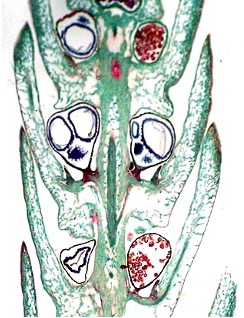
<p>Is this homosporous or heterosporous?</p>

Is this homosporous or heterosporous?

Heterosporous

4
New cards
<p>Is this plant homosporous or heterosporous?</p>

Is this plant homosporous or heterosporous?

Homosporous

5
New cards
<p>What is this?</p>

What is this?

An antheridial head

6
New cards
<p>What is this?</p>

What is this?

Moss protonema

7
New cards
<p>What is this?</p>

What is this?

An archegonium

8
New cards

What features do bryophytes lack that limit their size?

True roots, stems, and leaves as well as vascular tissue.

9
New cards

What is the function of rhizoids?

They anchor the plant and absorb nutrients.

10
New cards

What is the function of gammae cups?

Asexual reproduction (raindrops landing on the cup disperse the gemmae)

11
New cards

What is the role of the peristome in spore dispersal?

Releases spores in response to moisture.

12
New cards
<p>What is this?</p>

What is this?

A Marchantia Antheridiophore

13
New cards
<p>Is this strobili homosporous or heterosporous?</p>

Is this strobili homosporous or heterosporous?

It is heterosporous

14
New cards
<p>What is this and what is its function?</p>

What is this and what is its function?

This is an elater and it disperses spores

15
New cards
Green algae body complexity progression
Unicellular (Chlamydomonas) to colonial (Eudorina) to multicellular (Volvox).
16
New cards
Chlamydomonas body type
Unicellular (ancestral body complexity).
17
New cards
Eudorina body type
Colonial (intermediate body complexity).
18
New cards
Volvox body type
Multicellular (derived body complexity).
19
New cards
Green algae gamete evolution progression
Isogamous (Chlamydomonas) to anisogamous (Eudorina) to oogamous (Volvox).
20
New cards
Isogamous gametes example
Chlamydomonas (same-size gametes).
21
New cards
Anisogamous gametes example
Eudorina (different-sized motile gametes).
22
New cards
Oogamous gametes example
Volvox (different-sized, only male motile).
23
New cards
Green algae embryo protection progression
Unprotected (Volvox) to single cell (Oedogonium) to multicellular structure (Chara).
24
New cards
Embryo protection in Chara
Protected by a multicellular structure.
25
New cards
Trend foreshadowing land plant embryo
Egg and embryo protection, as seen in Chara.
26
New cards
Bryophytes - Habitat and Ecological Niche
Need wet environments to grow and thrive.
27
New cards
Bryophytes - Dominant Generation
Gametophyte generation is dominant.
28
New cards
Bryophytes - Water for Reproduction
Need water for reproduction.
29
New cards
Bryophytes - Units of Propagation
Uses spores dispersed via wind and water.
30
New cards
Bryophytes - Structural/Reproductive Innovations
Cuticle and multicellular gametangia.
31
New cards
Bryophytes - Evolutionary Strategy
Able to colonize harsh sites, but have no vascular tissue, are limited in size and are water dependent.
32
New cards
Bryophytes - Advances in Some Members
Stomata on some members (mosses).
33
New cards
Seedless Vascular Plants - Habitat and Ecological Niche
Wet habitats but can live in drier areas than bryophytes.
34
New cards
Seedless Vascular Plants - Dominant Generation
Sporophyte generation is dominant.
35
New cards
Seedless Vascular Plants - Water for Reproduction
Needs water for reproduction.
36
New cards
Seedless Vascular Plants - Units of Propagation
Uses spores dispersed via wind.
37
New cards
Seedless Vascular Plants - Structural/Reproductive Innovations
Vascular tissue and some have true roots, stems, and leaves.
38
New cards
Seedless Vascular Plants - Evolutionary Strategy
Larger sizes, better transportation of water. Their gametophyte is free and vulnerable and they need water for fertilization.
39
New cards
Seedless Vascular Plants - Advances in Some Members
Heterospory and vessel elements in some ferns.
40
New cards
Gymnosperms - Habitat and Ecological Niche
Can live in drier colder climates (live in conifer forests).
41
New cards
Gymnosperms - Dominant Generation
Sporophyte generation is dominant.
42
New cards
Gymnosperms - Water for Reproduction
Water is not needed for reproduction.
43
New cards
Gymnosperms - Units of Propagation
Reproduce using seeds and pollen dispersed via wind.
44
New cards
Gymnosperms - Structural/Reproductive Innovations
Seeds, seed coat, pollen, food reserves, and (2n) sporophyte embryo.
45
New cards
Gymnosperms - Evolutionary Strategy
Pollen grains take away need for water; seeds give protection and long-distance dispersal.
46
New cards
Gymnosperms - Advances in Some Members
Vessel elements in gnetophytes that evolved independent of ferns.
47
New cards
Flowering Plants - Habitat and Ecological Niche
Can live in almost all habitats.
48
New cards
Flowering Plants - Dominant Generation
Sporophyte generation is dominant.
49
New cards
Flowering Plants - Water for Reproduction
Does not need water for reproduction.
50
New cards
Flowering Plants - Units of Propagation
Reproduce using seeds enclosed by fruit dispersed via animals, gravity, etc.
51
New cards
Flowering Plants - Structural/Reproductive Innovations
Flowers, fruits, and double fertilization.
52
New cards
Flowering Plants - Evolutionary Strategy
Efficient seed dispersal and pollination.