KINE 3401 (Biomech. of human mov.) EXAM 1
 Call Kai
 Learn
 Practice Test
 Spaced Repetition
 Match
 Flashcards
 Knowt Play
1/86

There's no tags or description
Looks like no tags are added yet.
87 Terms
Goals of Biomechanics
• Improve performance and accelerate skill learning
• Identify mechanical contributors to injury
Biomechanics practical goals
-Improve performance
-Prevent injury
-Guide rehabilitation
-Improve equipment and training
Rigid Body Mechanics
assumes objects do not deform
Deformable-body mechanics
examines changes in shape under load
Fluid mechanics
examines motion through liquids and gases
Relativistic and quantum mechanics
important, but outside this course
Statics
-Is the object accelerating?
-At rest or moving with constant velocity
-Acceleration equals zero
-Forces and torques are balanced
Dynamics
-How is motion changing?
-Velocity changes
-Acceleration is not zero
-Forces or torques are unbalanced
Kinematics
-What motion occurred?
-Position, displacement, velocity, and acceleration
Kinetics
-What forces caused or resisted it?
-Forces, torques, and loading
Length measures position and distance
• SI unit: meter (m)
• Examples: sprint distance, jump distance, implement travel, athlete height
• Length combines with time to describe velocity
Time measures duration
• SI unit: second (s)
• Examples: reaction time, race performance, game time
• Small time differences can change performance outcomes
Mass determines inertia
• SI unit: kilogram (kg)
• Mass is the quantity of matter in an object
• Inertia is resistance to a change in motion
• More mass means more inertia
Mass
-Amount of matter, measured in kilograms
-Mass remains the same when location changes
Weight
-Force of gravity, measured in newtons
-Weight changes when gravitational acceleration changes
-W=mg (ex: kg*9.81m/s^2)=N
Force
-A push or pull
-Forces are exerted by objects on other objects
• An unopposed force can start, stop, speed up, slow down, or redirect motion
• SI unit: Newton (N)
• 1 N = 1 kg·m/s²
-Vector quantity
Vector
- Has magnitude and direction
- Arrow length represents magnitude
- Arrow orientation represents direction
Scalar
- Magnitude only
- Distance and speed
- Has magnitude but no direction
Magnitude
- How large is the force?
- Numerical size of a quantity
Direction and Sense
- Along what line and which way?
Point of application
-Where does the force act?
Internal forces
-Act within the body
-Do not change the motion of the body as a whole without external interaction
External forces
-Come from outside
-Must act to change whole-body motion
Gravity
-Continues to act downward
-g= 9.81m/s^2 near Earth's surface
Contact forces
-Requires touching objects
-Has two components (Normal force & Friction)
Normal force
Acts perpendicular to the contact surface
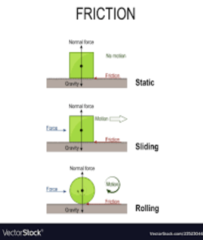
Friction
Acts parallel to the contact surface
Static friction
-Surfaces do not slide relative to each other
-Usually greater than dynamic friction
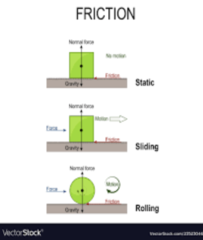
Dynamic friction
-Surfaces slide relative to each other
-Also called kinetic or sliding friction

Limiting friction
Maximum static friction before sliding
Coefficient of friction (μ)
-Describe surfaces
-μ represents the contacting materials
Net force-1
Combines external forces
Resultant force
Combined effect of all external forces
Colinear forces
Forces that act along the same straight line, sharing a single line of action, and their resultants are found by simple algebraic addition or subtraction
Concurrent forces
- Meet at one point
- The forces are not collinear
- Their lines of action pass through one point
- Horizontal and vertical components can be summed separately
Free-body diagrams
- Show forces
- A simplified sketch of one selected object or system
- Arrows show external forces acting on that system
- Isolates external forces
Static equilibrium
- Requires zero net force
- Acceleration equals zero (ΣFₓ = 0 and ΣFᵧ = 0)
- Forces may be present, but they balance
Explain why force is a vector
Its effect depends on both its magnitude and the direction in which it is applied
Identify the four characteristics of a force.
-Magnitude
-Direction
-Point of application
-Line of action
non‑contact force
act at a distance without any physical contact (e.g., gravity, magnetism, electrostatic forces)
The friction model is F = μR
• F: friction force
• μ: coefficient of friction
• R: normal contact force
• Example: μ = 0.50 and R = 400 N gives F = 200 N
Low μ
less friction, easier sliding
High μ
more friction, greater traction
Linear motion
• Linear motion is also called translation
• All points move the same distance & direction
• All points move during the same time interval
• The object does not rotate
Rectilinear Motion
-Straight-line path
-Orientation remains unchanged
Curvilinear Motion
-Curved path
-Direction changes continuously
Angular motion
• Also called rotary motion
• Points move through the same angle
• Motion occurs about an axis of rotation
• Ex: elbow flexion, a pirouette, a giant swing
General motion
• Combines translation and rotation
• Includes linear and angular motion
• It is the most common form of human movement
• Ex: walking, running, cycling, and throwing
Position
- Tells where an object is
- Requires a reference frame
- Location in space
Cartesian coordinate system
a method for uniquely locating points in a plane or space using numerical coordinates along perpendicular axes
Distance
- The length of the path traveled
- A scalar quantity
- Always zero or positive
Displacement
- Straight-line change from initial to final position
- A vector quantity
- Δx = xf − xi
- Δy = yf − yi
Resultant displacement
- Representing the net change in position of an object
- Δx and Δy are perpendicular components
- Rd = √[(Δx)² + (Δy)²]
Speed
- The rate of distance traveled
- Is a scalar
- Average speed = distance traveled ÷ elapsed time
- s = ℓ ÷ Δt
- SI unit: meters per second (m/s)
Velocity
- The rate of displacement
- The speed of an object moving in a specific direction
- Is a vector
- SI unit: meters per second (m/s)
Component velocities
Vx = Δx ÷ Δt and Vy = Δy ÷ Δt
Instantaneous velocity
- The velocity of an object at a specific moment in time
- It is a vector
- V= lim Δr/Δt= Dr/Dt
Average velocity
- Displacement ÷ elapsed time
- v = d ÷ Δt
Acceleration
- The rate of change in velocity
- Occurs when speed changes & when direction change
- Is a vector
- 𝜶 = (𝒗𝒇 − 𝒗𝒊)/(𝒕𝒇 − 𝒕𝒊)= (∆𝒗)/(∆𝒕) = (𝐦/𝐬)/(𝐬) = 𝐦/𝐬𝟐
Uniform acceleration
- The motion of an object in which its velocity changes at a constant rate over time
Projectile motion
- The motion of an object that is launched into the air and moves along a curved path under the influence of gravity alone
Kinetics
Explains changes in motion & forces that cause motion
Newton's First Law
- Law of Inertia
•An object at rest remains at rest
•An object in motion continues at constant velocity
•A net external force is required to change motion
Newton's Second Law
- The Law of Acceleration
- Force changes velocity
- Acceleration depends on net force and mass
•A net external force causes acceleration
•More net force produces more acceleration when mass is constant
•More mass produces less acceleration when net force is constant
•Acceleration is the rate at which an object's velocity changes over time.
•Acceleration may change speed, direction, or both
Newton's Third Law
- The Law of Action-Reaction
•For every action force, there is an equal and opposite reaction
force
•The two forces act on different objects
•Ground reaction forces support and accelerate the body (ex: water resistance and air resistance)
Inertia
- Resistance to a change in motion
- Directly related to mass
•At rest: an object resists beginning to move
•In motion: an object resists stopping or changing speed
•In direction: an object resists changing its path
net force
- Vector sum of all forces acting on an object, determining its acceleration according to Newton's second law
- Zero net force means velocity does not change
- At rest + zero net force → remains at rest
- Moving + zero net force → continues at constant velocity
Ground reaction force
Support and accelerate the body
Horizontal Reaction Force
(Rx) Refers to any force, positive or negative, that occurs on the x-axis
Vertical reaction force
(Ry) Refers to any force, positive or negative, that occurs on the y-axis
Momentum
- Describes mass in motion
- Physical property of a moving object that keeps it in motion
- A vector quantity
- Depends on both mass and velocity
-An object with greater momentum is harder to stop or redirect
Linear momentum
L(p)= mv
L(p)= Linear momentum (kg*m/s)
m = mass (kg)
v = velocity (m/s)
Momentum has the same direction as velocity
Conservation of momentum
total momentum of an isolated system remains constant when no external forces act on it
Impulse
- Combines force and time
- Equals the change in momentum
- J= Impulse (N*s)
- F=average force (N)
- Δt = force-application time (s)
- J = FΔt = m(vf − vi)
Impulse-Momentum Relationship
The impulse applied to an object is equal to the change in its momentum, linking force, time, and motion
Force, mass, and acceleration
Situation
Net force increases
Mass increases
Net force = 0
Result
Acceleration increases
Acceleration decreases
No acceleration
Net force determines how the bar moves
•Upward hand force > 44.15 N → upward acceleration
•Upward hand force = 44.15 N → zero acceleration
•Upward hand force < 44.15 N → downward acceleration
Mechanical work
- Requires force and displacement
- Occurs when a force causes an object to move
•Requirement 1: a force acts on the object
•Requirement 2: displacement occurs in the force's direction
•No displacement → no mechanical work on the object
•No applied force → no mechanical work
Positive work
Force and displacement act in the same direction
•Adds mechanical energy to the object
Negative work
Force and displacement act in opposite directions
•Removes mechanical energy from the object
•Positive and negative describe energy transfer; not good or bad
Energy
• The ability to perform work
• Energy is the capacity to produce movement or cause change
• Energy may be stored, transferred, or transformed
• Energy is not created during movement
• When work is performed, energy moves from one system to another
Kinetic energy
- Energy due to motion
- Depends on mass and speed
- Every moving object has kinetic energy
- A heavier object has more kinetic energy at the same speed
- A faster object has more kinetic energy at the same mass
- Because velocity is squared, speed has a large effect on kinetic energy
- KE = ½mv²
- KE = kinetic energy (J)
- m = mass (kg)
- v = velocity (m/s)
- If velocity doubles, kinetic energy becomes four times larger
Potential energy
- Is stored by position
- Depends on mass, gravity, and height
- Gravitational potential energy depends on vertical position
- A higher object has more potential energy
- Gravity can convert stored energy into motion
- An object can have potential energy even when it is not moving
- PE = mgh
- PE = potential energy (J)
- m = mass (kg)
- g = gravitational acceleration (9.81 m/s²)
- h = height above the reference level (m)
Mechanical energy
- Combines motion and position
- ME = KE + PE
- ME = total mechanical energy
- KE = kinetic energy due to motion
- PE = potential energy due to position
- Most moving objects have both kinetic and potential energy
Work-Energy Relationship
The work done on an object results in a change in its energy, and energy is defined as the capacity to do work.
Power
- Measures how quickly work is performed
- P = W/t
- P = power (W)
- W = work (J)
- t = time (s)
- 1 watt = 1 joule/second
- Depends on both the work performed and how quickly it is completed
Mechanical power
The rate at which work is done or energy is transferred by mechanical forces, measured in watts (W)