HLSC280 Exam 3
 Call Kai
 Learn
 Practice Test
 Spaced Repetition
 Match
 Flashcards
 Knowt Play
1/85

There's no tags or description
Looks like no tags are added yet.
86 Terms
Questions genome annotation can answer
Which sequences code for proteins, structural RNAs, non-coding RNAs, small RNAs, regulatory signals (promoters, terminators, polyadenalation, splicing, ribosomal binding, transcription factor binding)?
What is the function of the predicted gene products? of various genomic features?
Can we link genotype to phenotype?
Can we trace the evolutionary history of an organism from its genomic sequence and genome organization? Can we follow the evolutionary history of a pathway?
What are DNA sequence motifs?
Sequence motifs are short, recurring patterns in DNA that are recognized as a signal by the cellular machinery.
What do DNA sequence motifs often indicate?
Sequence-specific binding sites for proteins such as nucleases and transcription factors.
What important processes are motifs involved in at the RNA level?
Ribosome binding
mRNA processing (splicing, editing, polyadenylation)
Transcription termination
What do intron splice sites most commonly have at the end of the sequence?
Ends with the dinucleotide AG.
What is a position weight matrix?
A position weight matrix is commonly used statistical representation of motifs in biological sequences like nucleic acids and proteins. They are also a tool for computational motif discovery (i.e. finding new sequences with the same pattern).
How are PWMs contructed?
It always starts with a multiple sequence alignment (MSA) of functionally related sequences.
The MSA is converted to a position frequency matrix (PFM).
The position frequency matrix (PFM) is converted to a position probability matrix (PPM).
The position probability matrix (PPM) is converted using a background model b. Pseudocounts are also added converting 0s to really small values (dependent on sig figs for matrix).
Finally PPM is turned into a PWM by calculating each element with a log2 calculation.
Order of matrices to make a PWM
MSA → PFM → PPM → Pseudocount PPM → PWM
Where are multiple sequence alignment initially derived from?
Experimental evidence pointing to their shared characteristic
Computational evidence of searches for overrepresented (and/or conserved) DNA patterns upstream of functionally related genes (e.g. genes with similar expression patterns or similar annotation).
Relationship between experimental computational motif discovery and experimental validation in genome annotation
Experimental efforts lag behind computational predictions, creating a gap that computational modeling helps bridge.
What does a position probability matrix (PPM) allow you to do?
Makes it easy to calculate the probability of a sequence, by multiplying the relevant probabilities at each position.
What are the simplest background model (b) value used when converting a PPM?
0.25 (1/4) for nucleotides and 0.05 (1/20) for amino acids.
What are pseudocounts and why are they necessary?
Pseudocounts are the minuscule values used to substitute 0s in a PPM before the log2 conversions. They are necessary as without them, log2 calculations with 0s result in -∞ that mess with the additive calculations.
What does a position weighted matrix allow you to do?
When the PWM elements are calculated using log likelihoods, the score of a sequence can be calculated by adding the relevant values at each position in the PWM.
Explain the relationship with PWM scores and sequence representation?
Higher PWM scores express a better correspondence to the PWM model and thus a higher likelihood that the sequence represents a functional site.
Computational (predictive) gene finding occurs through
Identification of Open Reading Frames (ORFs) - common in prokaryotes
Examination of base composition differences between coding vs non-coding regions
Ab initio computational gene recognition (exons, introns, exon-intron boundaries) using a variety of gene-finding algorithms
What is an Open Reading Frame (ORF)?
An ORF is a segment of DNA, a potential protein-coding-sequence, identified by an initiator codon in frame with a chain-terminating codon.

Describe what is going on in this image
Colored lines indicate computationally predicted potential ORFs in all six reading frames. ORFs shown in purple have experimental evidence supporting expression, based on mRNA or protein sequencing.
Coding regions are often characterized by what?
Higher GC content
What are pseudogenes?
Pseudogenes are genes overtime that contain many stop codons but still have high GC content.
Stop codon is AT-rich, so…
Less AT suggests less stop codons and more GC content.
An Hidden Markov Model is represented by:
A finite set of states (Q)
A finite alphabet (α)
A transition distribution (Pt)
An emission distribution (Pe)
HMMs are examples of Probabilistic Methods which:
Create models that have a probability of generating any given feature/signal (exon, intron, UTR, etc)
Train the models using examples (typically defined experimentally) of the types of feature to generate
The “score” of the feature (string S) is the probability of the model generating it.
During training of a gene finder…
only a subset K of an organisms gene set will be available for training (those would have typically been determined experimentally).
Make sure that your test set meets the following two conditions:
Is large enough to yield statistically meaningful results.
Is representative of the data set as a whole. Don’t pick a test set with different characteristics than the training set.
Sensitivity Equation
TP = True Positive
FN = False Negative

Specificity Equation
TN = True Negative
FP = False Positive

What is the problem with inferring gene product function through transitive annotation?
Scientists normally assign function through homology to well characterized proteins (using tools like BLAST) but transitive annotation can lead to errors that propagate. Several types of evidence should be used when annotating a predicted gene product.
What is Gene Ontology (GO)?
It is a set of dynamic controlled vocabularies used to describe gene products in terms of their associated biological processes, molecular functions, and cellular components in a species-independent manner.
What are the three ontologies?
Biological Process
A biological objective
Has more than one distinct step
Molecular Function
What the gene product does
Think “activity”
Cellular Component
Location in the cell (or smaller unit)
or part of a complex
Inferring gene product function by other means:
Examining protein domains and protein families
Expression profile of mRNA/protein
What is a protein domain?
A domain is a region of a protein that can adopt a particular 3D structure. Each domain can be independently stable and folded. Domains vary in length from between about 25 amino acids up to 500 amino acids in length.
Domains often form…
function units such as the calcium-binding EF hand domain of calmodulin.
Domains can…
Extend along the length of a protein
Occupy a subset of a protein sequence
Occur one or more times in a single protein
Occur in different proteins in the same organism

The most and least common domain in humans is
Zn finger, C2H2 type with 1093 proteins.
Caherin with 226 proteins.
True or False: a protein can have more than one domain.
True
What is a domain family?
Together a group of proteins that share a domain is called a family. HMM comainds can also be defined and used to group proteins into families.
How can the domain content of an entire proteome be computed?
Take all the proteins of a genome
HMM search against protein family profiles
Alignment search against homology based domain alignments
The search results are stored in the database in the form of domain-based alignments
Organize the proteins into domain-based paralogus families

Transcriptome profiling and its applications
Annotation of gene function/definition of genetic pathways
Detection of candidate genes
Molecular phenotyping/specimen classification
Study of developmental processes
Clinical assessments/diagnoses
Curation of gene structure
Powerful tool for generating and testing hypotheses
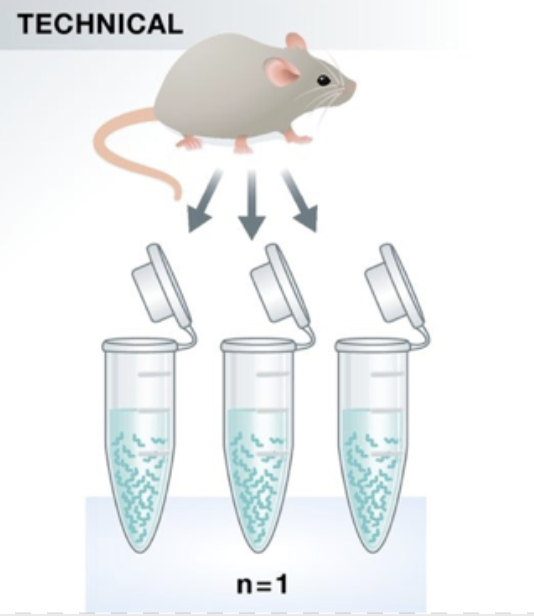
Technical replicates
Are repeated samples of the same biological material. it is carried out to assess the reproducibility (or technical variation) of a technique or assay.
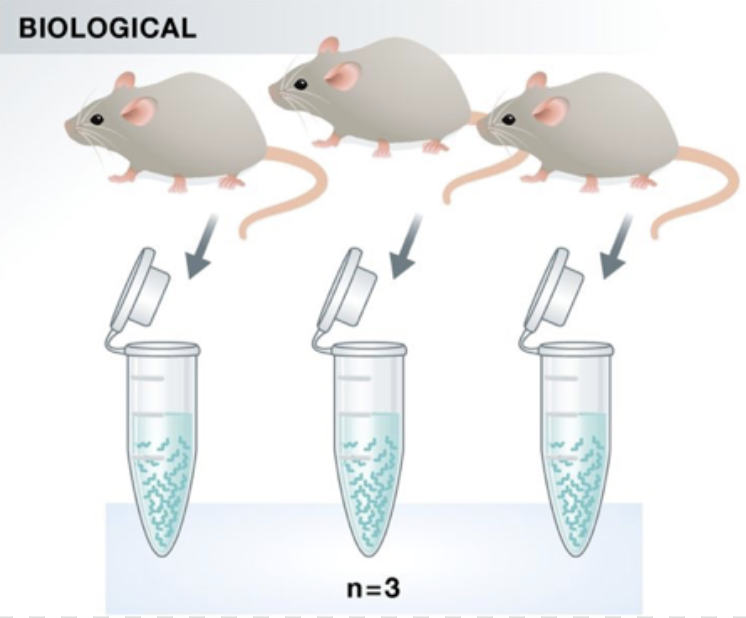
Biological replicates
Are independent samples of similar material (e.g. differen mice from the same strain, similar tumor samples from different individuals, independently cultured batches of cells…). Biological replicates are used to capture biological variation.
All steps for gene expression profiling (step 1)
Experimental Design
Frame a biological question
Design your experiment, including the sample contrasts
Decide on biological and technical replicates
Technical Performance
Obtain the samples and preserve them
Isolate RNA. Check quality and quantity.
Construct libraries and sequence at the desired depth.
All steps for gene expression profiling (step 2)
Statistical Analysis
Map and count reads
Normalize counts and compute CPMs/RPKMs
Pairwise comparisons (t-tests, ANOVA,…)
Data mining
Cluster and pattern recognition
Examine lists of Gene Ontologies
Search for domains and regulatory motifs
For data mining, genes can be…
clustered and grouped based on gene expression patterns. You can use functional inference to see how unknown genes may work due to similarities when clustering by patterns.
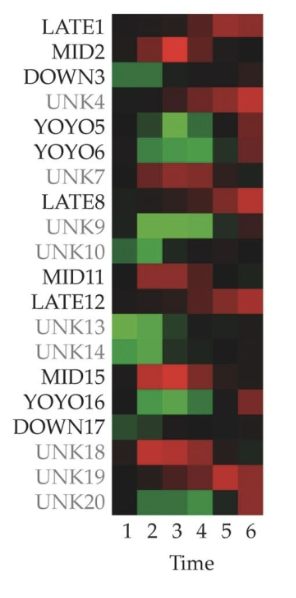
What is the compendium approach?
It consists primarily of a comprehensive analysis of the transcriptome profiles obtained from a large number of samples including multiple replicates, followed by a hierarchical clustering of expression profiles by pattern similarities between the samples and between genes.

What is the proteome?
The proteome refers to all the proteins in a cell and/or all the proteins in an organism
What is 2D Gel-Electrophoresis?
Protein separation through IEF (separation by isoelectric point (pl)) and SDS-PAGE (separation by molecular weight (MW)).
First dimension of 2D protein gels: isoelectric focusing
Establish a pH gradient on gl matrix using ampholytes
Proteins migrate to their isoelectric point (pl) then stop when their net charge is zero
Range of pH typically 4-9 (5-8 most common)
Second dimension of 2D protein gels: SDS-Page
Electrophorese proteins through an acrylamide matrix
Proteins are charged and migrate through an electric field
Conditions are denaturing
Can resolve hundred to thousands of proteins
Multiple spots for same protein in 2D gel can be attributed to
Post-translational modifications
Protein isoforms (alternative splicing)
Proteolysis (i.e. protein degradation)
Advantages of 2D gels (IEF/SDS-PAGE)
Separate and visualize hundreds to thousands of proteins
Facilitate identification of protein spots
Disadvantages of 2D gels (IEF/SDS-PAGE)
Limited number of samples can be processed
Technically difficult
Only mostly abundant proteins are visualized
Peptide Mass Fingerprint (PMF) Steps
An unknown protein which is often excised from the 2D gel is treated with trypsin to break it down into smaller peptide fragments.
Resulting peptide mixture is analzyed by a Mass Spectrometer. The instrument measures the mass to charge (m/z) ratio of each peptide fragment, producing a distinct observed mass spectrum
From the genome database of the organism, all protein sequences are collected, subjected to a simulated trypsin digest, and calculates the theoretical peptide masses for ever protein.
The algorithim contrasts the experimentally observed mass spectrum against all computer-generated theoretical spectra. A statistically significant match between the observed and theoretical peptide masses identifies the unknown protein.
Describe the trypsin specificity
Trypsin is a highly specific enzyme that cuts peptide bonds strictly after Lysine (K) or Arginine (R) residues, except when either is folowed by Proline (P).
The c- and z- ladder series in a MS2 or MS/MS spectrum is a result of a breakage at the:
carbonyl carbon - amide nitrogen bond
Why do fragments in theoretical spectrum not have varying abundances?
The predicted spectrum is obtained in silico by using basic bond-cleavage rules rather than modeling real life reaction kinetics. Predicting exact peak intensitites requires simulating complex calculations not fit for regular computers.
Peptide Mass Fingerprint (PMF) Advantages and Disadvantages
Advantage: Only the masses of the peptides have to be known (so de novo sequencing of the protein is not necessary)
Disadvantages:
The protein sequence has to be present in the database of interest (i.e. the genome should be sequenced and all genes well characterized)
PMF algorithms assume the peptides come from a single protein
Describe the steps of proteome analysis by MS-MS

Explain the peptide fragmentation process
A selected precursor ion enters a collision field filled with neutral gas, undergoing Collision-Induced Dissociation (CID) to break peptide bonds along the linear amino acid backbone.
Explain the de novo interpretation
As the precursor ion is hit with the neutral gas and undergoes CID, the ion is split up into many b-ions (positive charge on the n-terminus) and y-ions (positive charge on the c-terminus). This means that by subtracting the bi and bi+1 or yi and yi-1, you should be able to determine the residual mass of the amino acid added to that position.
Advantages and Disadvantages of De Novo interpretation
Advantages:
Simple peptide fragmentation model
Usually many apparently good solutions
Disadvantages
Amino-acids have duplicate masses
“Best” de novo interpretation may have no biological relevance
Identifies relatively few peptides in high-throughput workflows
Microbiota definition
The microorganisms of a particular site, habitat, or geological period
Microbiome definition
The combined genetic material of the microorganisms in a particular environment
Gut microbiota performs 4 important functons
Produces butyrate, the preferred energy source of the colonic epithelia
Produces essential vitamins
Balances and educates the immune system
Confers colonization resistance to pathogens
Intact colonization resistance
Rejection of foreign species/strains
Impaired colonization resistance
Engraftment of foreign species/strains
Suboptimal facets of our gut microbiota
Converts choline into Trimethyl Amine (TMA), which is implicated in cardiovascular disease
Modifies drugs into inactive forms
Produces gases responsible for many common gastrointestinal symptoms
Imbalances immune system of genetically susceptible individuals (IBD)
What breaks down oligosaccharides and polysaccharides into monosaccharides
Glycoside hydrolases
Taxonomy
Dear King Philip Came Over For Good Soup
Major problems with physiological characterization of bacteria
Lots of work
Only works for cultural microbes
Convergent evolution
Resulted in a bacterial taxonomy that was utter chaos (often assigned into the wrong phylum)
Why was rRNA a good choice for Carl Woese
Present in all life forms
Highly conserved
Why was 16S ribosomes chosen?
Sanger had a limit of 800 bp per read, but you can sequence both sides so it allowed for 1600 bp. 5S was too short and 23S was too long, but since 16S was 1550 bp, it was just right.
More critical features of 16S that made it ideal
Highly conserved regions in bacteria and archaea allow for the design of universal primers
Variable regions allow for relationships to be analyzed
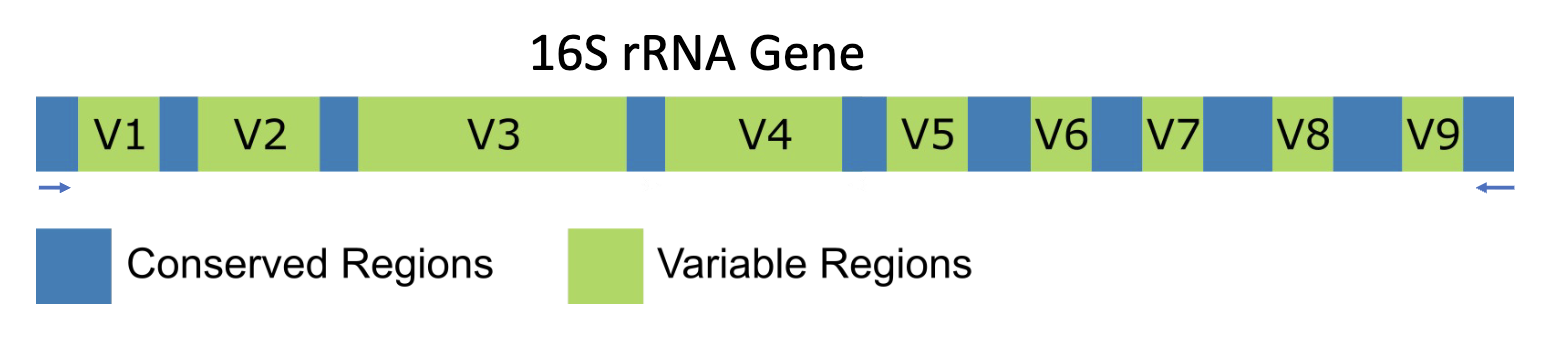
Why does the 16S rRNA gene have highly conserved regions?
The highly conserved regions mediate base pairing crucial for the rRNA to assume the correct secondary structure.
16S vs 18S
16S is found in bacteria and archaea, while 18S is found in eukaryotes.
Metagenomics definition
The study of genetic material recovered directly from environmental samples
High-level 16S Sequencing Overview
Genomic DNA from environmental sample + Universal 16S rRNA primers
PCR Amplification
Sequencing
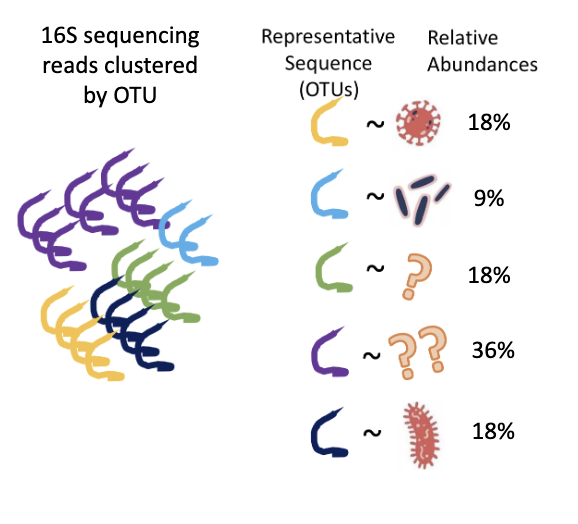
16S sequencing reads
OTU Clustering
Operational Taxonomic Unit (OTU)
A cluster of (uncultivated or unknown) organisms, grouped by DNA sequence similarity of a specific taxonomic marker gene
A proxy for a bacterial or archeal Genus/Species name in 16S rRNA analysis
Prominent databases for mapping OTUs to known 16S sequences
Silva, GreenGenes, the Ribosomal Database Project, and UNITE.
Once representative OTUs are identfied…
The relative abundance of each OTU can be calculated. This gives us an idea of the relative abundance of each organism. Relative abundance does not correspond to absolute abundance.
Advantages of 16S rRNA sequencing
Cheap because relatively few reads are needed
Hundreds of samples for 16S sequencing are often multiplexed on a single illumina lane
Enables metagenomics of samples with low bacterial biomass
Enables metagenomics of samples with predominantly non-bacterial DNA
Tissue biopsy
Tiny animals, such as insects
Disadvantages of 16S rRNA sequencing
Copy number variation of 16S gene - can complicate the estimation of relative abundance
PCR Amplification biases
PCR Chimeras - can create artifactual results when two 16S rRNA genes from different species are erroneously spliced together by the PCR reaction
Limited taxonomic resolution - because we are still limited to data from a single gene (the 16S rRNA gene)
Whole metagenome sequencing (WMS)
If the sample is large enough, and contains enough microbial DNA, it is possible to sequence all DNA in a sample without preamplification as in 16S rRNA gene sequencing. Allows for strain-level taxonomic profiling but also functional profiling.
Whole Metagenome Sequenceing process

Pangenome definition
A complete collection of all the genome sequences and genetic variation found across multiple individuals, strains, or populations of the same species or clade.
Advantages of whole metagenome seuqencing
Better taxonomic resolution
Allows for strain-profiling by examining Single Nucleotide Polymorphisms
Allows for pangenome analysis
Allows for functional profiling
Metagenomic assembly can be used to reconstruct individual bacterial genomes.