SA ophthalmology 4 - uvea & lens
 Call Kai
 Learn
 Practice Test
 Spaced Repetition
 Match
 Flashcards
 Knowt Play
1/52

There's no tags or description
Looks like no tags are added yet.
53 Terms
What are the components of the uvea?
Anterior uvea
Iris
Ciliary body
Posterior uvea
Choroid
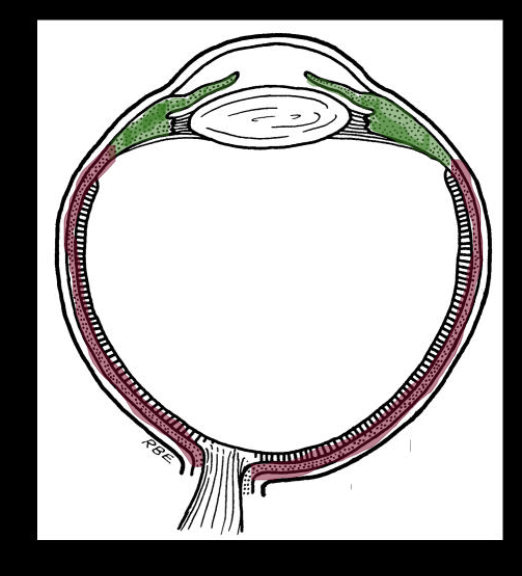
What are the features of the uveal tract & its functions?
Vascular, pigmented.
Immunologically reactive
Controls light entering the eye
Structural support & accomodation of lens
Aqueous production & drainage
Nutrition
Gas exchange
Light absorption / reflection
What are the areas of the iris?
Ciliary zone —> outer
Pupillary zone —> inner
Collarette (where persistent papillary membrane originates) —> embryological remnant
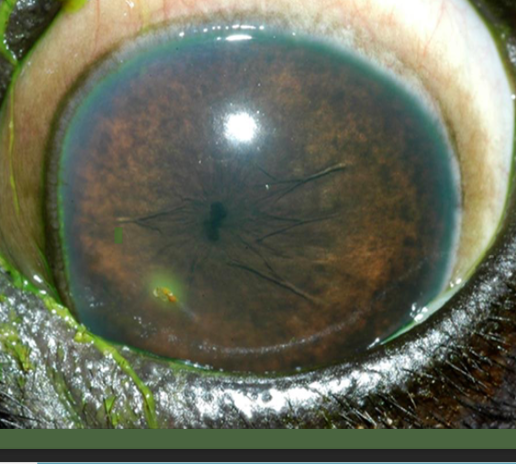
Pectinate fibres, anterior border, stroma (sphincter m.), posterior ep. (dilator m.)
What are the features of the pupil?
Dilator m. —> sympathetic (long ciliary nn. CN5) —> radial fibres
Constrictor m. —> parasympathetic (CN3) —> circular fibres
Mydriasis = dilates
Miosis = contricts
What are the features of the ciliary body?
Cont. w/ iris
Smooth mm., parasymp
Ciliar cleft —> trabecular network
Pars plicata —> ciliary processes
Zonular fibres —> support lens

What are the layers of the choroid?


List the uveal developmental dxs
Aniridia —> abscense of iris
Coloboma —> abscence of part of iris
typically arise @ optic fissure
atypical —> anywhere else
Heterochromia iridis —> incomplete development, thinning (uncommon)
affects light coloured irises usually
Subalbinimis
Merle ocular dysgensis —> genetic disorder w/ multiple abnormalities
Anterior segment dysgenesis
Perisistent pupillary membrane remnants —> usually gone by 6 wks pp
Anterior Segment Dysgenesis —> malformation of anterior segment
Faulty separation of cornea, iris and lens, potentially leading to shallow anterior chamber, faulty drainage, cataract & glaucoma
List the acquired dxs of the uvea?
Iris atrophy
Iris melanosis
Uveal cysts
Uveitis
Neoplasia
What is your main differential for PPMs (persistent pupillary membrane) remnants?
Synechiae —> but come from pupil margin not collarette
What is being shown here?
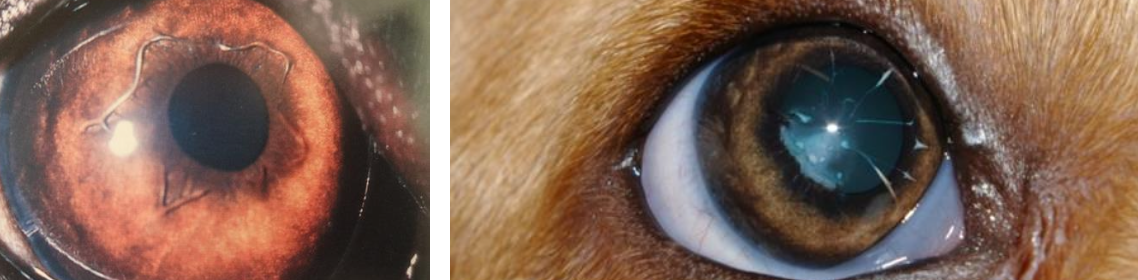
PPMs
What are the colour alterations you can get in the iris?
Albinism —> abscence of melanin
Subalbinism —> partial red in pigment
Heterochromia irides —> iris colour diff between eyes
Heterochromia iridis —> colour diff in same iris
What breeds are predisp to merle ocular dysgensis?
Australian Shepherd
Shelties
Great Danes
Sheepdogs (Old English and
Rough/smooth collies)
What does merle ocular dysgenesis cause?
Iris heterochromia
Iris hypoplasia
Iris colobomas
Corectopia
Dyscoria
Microphthalnia
Cataract
Retinal dysplasia
Staphyloma
What are the features of iris atrophy?
Age related finding
Thin iris stroma
Poor/absent PLR
Strands at pupillary margin
Photophobia

What are the features of uveal cysts?
Thin, pigmented, fluid filled structures
Transilluminate
Float in aqueous / found in ventral anterior chamber
Labs / Golden retrievers
Assymp unless large / obstructive
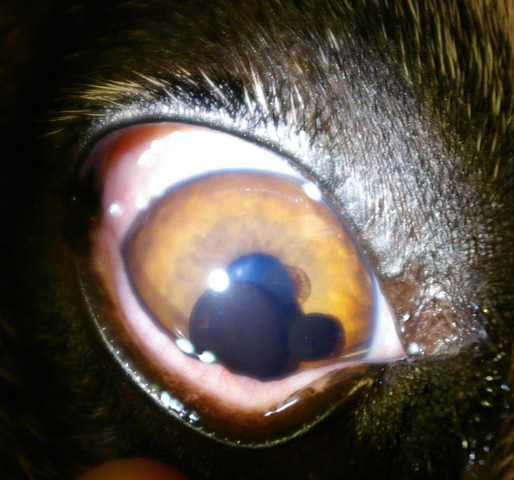
What is the different between iris naevus and melanosis?
Naevus
focal, benign, flat, progressive-slow
benign
Melanosis
extensive
progressive
potensh malig transformation → Feline diffuse iris melanoma (FDIM)
What are the ddxs for uveal masses?
Naevi (flat + focal)
Iris cysts (transilluminate/US)
Melanoma
Ciliary body adenoma
Lymphoma
Metastatic neoplasms
What are the uveal neoplasias?
Anterior uveal melanoma / melanocytoma
Commonest intraocular tumour
solid mass
mostly pigmented
low metastatic rate but may become malig
Limbal melanoma
Ddx —> nodualr episcelritis (nonpigmented)
slow growth
v. pigmented
originat @ limbus
locally invasive (cornea & sclera)
Ciliary body adenoma
Pink mass
Visible through pupil
slow growth
enucleation curative
Lymphoma
Metastases
List some causes of uveitis
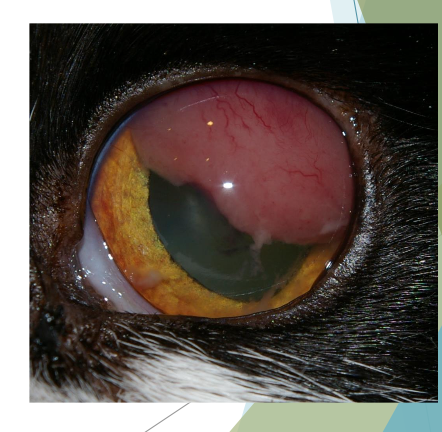
Infectious/pyometra
Lens induced
Immune-mediated
Trauma-cornea
Toxic
Metabolic
Reflex-ulcers
Toxic
Idiopathic
Neoplastic —> lymphoma, adenocarcinoma

What is blue eye?
Uveitis due to CAV-2 live vaccine / CAV-1 infection
2 wks after infection / vacc
Unilat / bilat
ag-ab complex deposition on corenal ep. → oedema
Dense corneal oedema “blue eye” —> resolves slow / keratoconus
Secondary glaucoma / blindness worst cases
What are the clinical signs of uveitis?
Pain blepharospasm/ photophobia/ lacrimation/ enophthalmos
Red eye-episcleral vascular congestion
Aqueous flare
Miosis
Reduced IOP
Hyphaema
Iris change appearance —> swelling/colour
Corneal oedema
Keratic precipitates —> focal deposits of inflammatory cells ventral endothelium
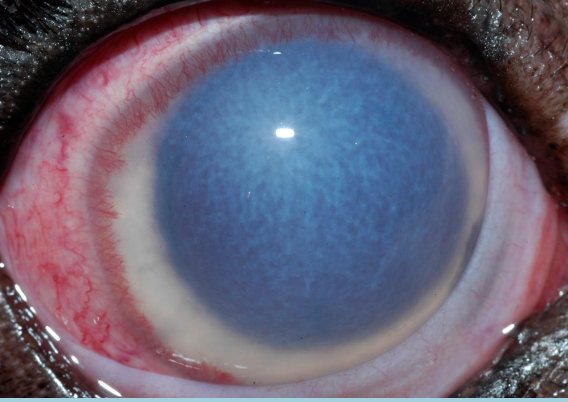
What is this?
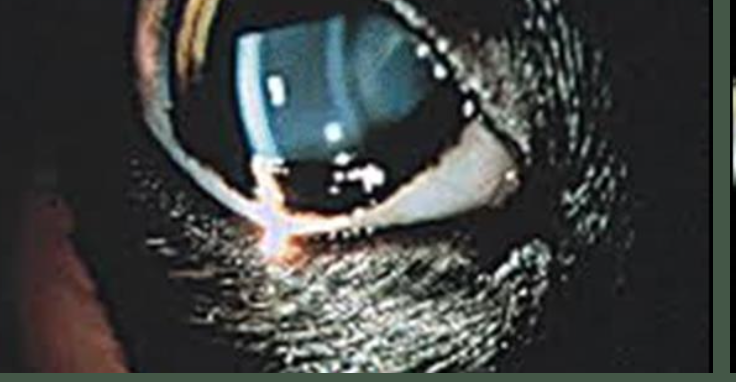
Aqeuous flare —> pathognomic for uveitis (hazy appearance in eye)
(Breakdown of blood aqueous barrier)
What is this?
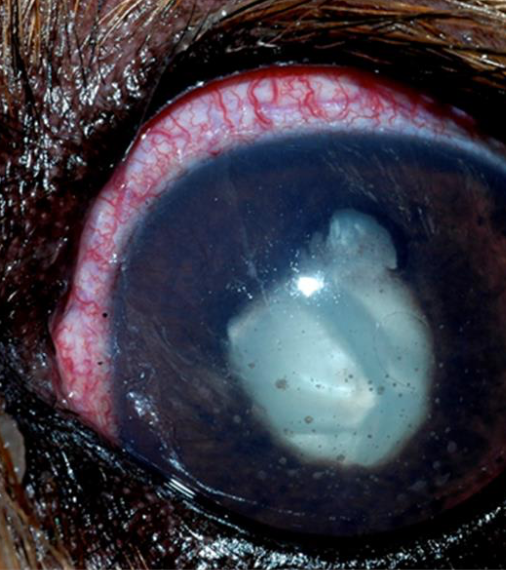
Keratic precipitate
What are the signs of chorioretinitis?
Tapetal hyporeflectivity —> oedema
Perivascular cuffing
Retinal haemorrhage
Retinal detachments
What are the signs of chronic uveitis?
Hypopyon
Keratic precipitates
Posterior synechiae (iris sticking to lins)
Iris rests —> pigment in lens capsule
Iris hyperpigmentation
Cataract
Glaucoma
How is chronic uveitis treated?
Treat cause
Predisology acetate —> drug oof chouce for stabilising brain ocular barrier & intraocular inflam
Anti-inflams (topical & systemic)
midriatics —> atropin, rocmydracil
When is prednisolone acetate contraindicated?
Ulcers
Glaucoma —> effects IOP
Corneal dx (exarcebates keratomalacia, Ca degen)
When is atropine contraindicated?
Glaucoma
KCS
Lens luxation
What is the function of the lens?
Accommodation
Refraction —> focuses light on cornea
Supports iris
Protects retina by blocking UV wavelength & UV-B radiation
Supported by suspensory ligaments & nutrients from aq humour
Summary of differences between nuclear sclerosis & cataract?

What uveitis can lens damage cause?
Lens induced uveitis
Immune response to lens ag in aq
Incr severity in old patients
Phagolytic
Phacoclastic uveitis
Inflam response to massive release of lens protein
Intact lens ags in aq
cell mediated & delayed tyoe of hypersens resoponse
Ruptured lens capsule
Trama / diabetic
How are the lens, uvea, cataracts and glaucoma related?
All interelated, are all causative to each other
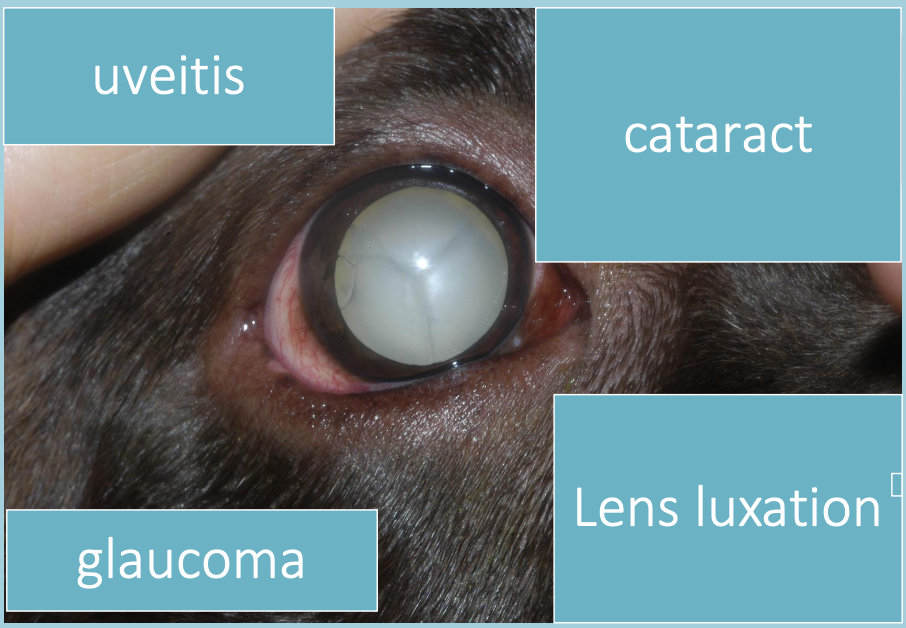

What are the stages of development of a cataract?
Incipient
<15% lens, fundus exam possible, patient visual
Sx not required
no detectable lens induced uveitis
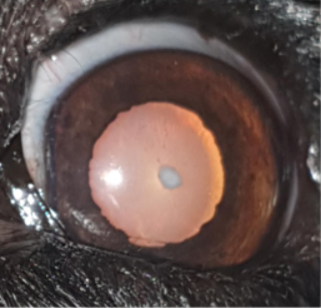
Immature
15-199% of lens
Tapetal reflex visisble
Signs of lens induced uveitis dependent on extent

Mature
Complete opacity, fundus not visible, no tapetal reflex
Lens induced uveitis present, vision loss, PLR / dazzle present

Hypermature
Liquified cortex, wrinkled capsule due to reduced lens vol
severe lens induced uveitis
may become morgagnian —> nucleus sinks in capsule
poor prog

What is the aetiologiy of cataracts?
1° —> inherited
2° —> trauma, metbolic, toxic, senile, nutritional, radiation, inflam, electrocution
How are cataracts classifed?
Congen
Hereditary
Diabetic
Traumatic
Senile
Spontaneous/Idopathic
Iatrogenic
Describe developmental cataracts
Begin in foetus, present @ birth
Progressive / static
Inherited / in utero infection / tox
Secondary to other developmental abnormalities
What are the features of senile cataracts
Opacification of nucleus
Nuclear sclerosis prsent (age)
Slowly progressive
Radial spokes into cortex

What causes traumatic cataracts?
What is needed to manage it?
Penetrating corneal injury → lens damage
Thorn / cat claw / bite
Blunt trauma
Septic implantation syndrome poss
Management:
Mydriasis essential
Phcoclastic uveitis → urgent referral
What can cause metabolic cataracts?
Diabetes (not in cats usually —> resistant to diabetic cataract formation but diabetes mellitus usually in older cats)
Bilat, quick onset
lens induced uveitis
tear changes
can develop overnight / over weeks

Cushings
Hypocalcaemia
How do you treat a diabetes melllitus cataract patient?
Stabilise
Refer
Control potential sources of endopthalmatits —> dental / UTI etc.
Early surgical intervention
What can diabetes cause in the cornea?
Significant reduction in corneal sensitivity
Trigem n. dysfunction
Incr incidence corneal ulceration
Non healing ulcers

What are some secondary causes to cataracts?
Intraocular dx —> uveitis, glaucoma, lens luxation, retinal atrophy
Nutritional —> inappropriate milk replacer diet, def essential AA’s, vit E def
Toxic —> ketoconazole → bilat progressive cataracts long term admin
Systemic dx —> uveodermatologic syndrome, CAV-1, Mareks dx, avian encephalomyelitis, trematode larvae
What parasite can cause cataracts?
Encephalitozoon cuniculi
What causes feline cataracts?
1° less common than dogs
Uveitis
Pentrating injury
E. cuniculi
How are cataracts diagnosed?
Hx of vision loss / impairment, change of appearance, change in behaviour
Direct ophthalmoscopy —> obstruction of tapetal reflex
U/S

DNA test —> hereditary?, HSF4 gene mutation, autosomal recessive, from 8-12wks
What breeds are predisposed to progressive retinal atrophy (PRA)?
Labs, cockers, poodles
Retinal degen → cataracts
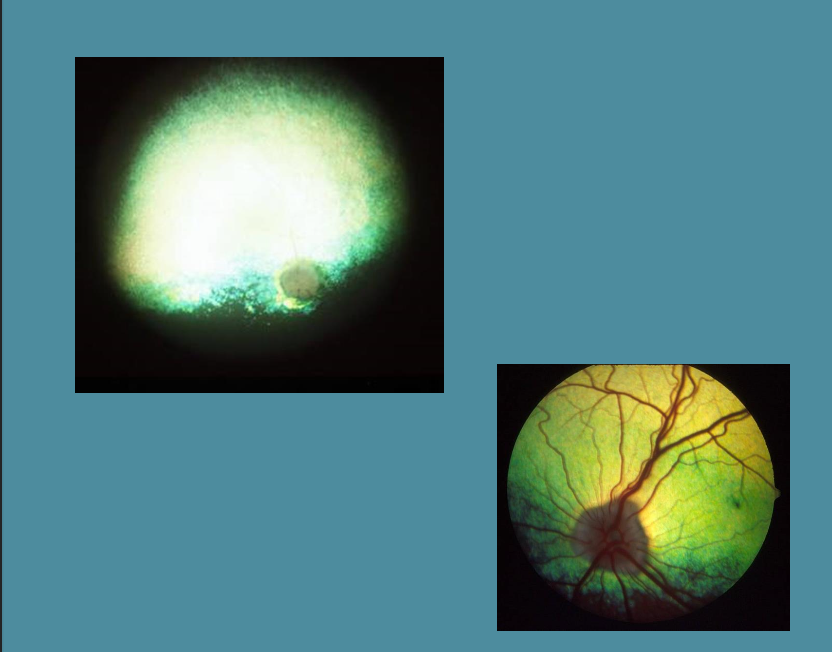
How are cataracts treated?
Medically
Treat lens induced uveitis
Mydriasis
Surgically —> early referral = better outcome
higher success rate for immature vs mature
less lens induced uveitis, easier sx
What are the post op complications of cataract surgery?
Hyperopia
lens induced uveitis
postoperative ocular hypertension(POH)
posterior capsule opacification (PCO)
Glaucoma
Endopthalmitis
Retinal detachment
What happens if you leave cataracts untreated?
Chronic lens induced uveitis
Glaucoma
Lens luxation
Retinal detachment
Rupture → phacoclastic uveitis
Phthisis bulbi
What are the types of lens luxations?
1°= abnormality of zonule, bilat but not simultaneous
risk of gluacoma = urgent tx
2°= to trauma, glaucoma, cataracts
Emergency
Anterior or posterior
How does anterior vs posterior luxation present?
Anterior —> sudden onset, pain, glaucoma, visual impairment, corneal oedema, red eye
Posterior —> deep anterior chamber, iridodonesis, aphakic crescent
What are some signs of lens subluxation?
Iridodonesis —> wobbly iris
Phacodonesis —> wobbly lens
Vitreous prolapse —> wisps of cotton wool in AC usually @ pupil
Anterior chamber depth —> deeper if lens subluxated posteriorly
Inflam
How can you treat lens luxation?
Surgical:
Transcorneal reduction+miotic
Open sky lendectomy
Phacoemulsification
+/- sutured intraocular lens
Subluxation:
Miotic
Elective sx better results intraocular lens / capsular tension ring
Medical:
Carbonic anhydrase inhibitors
Anti-inflams
Analgesia
Miotics —> if posterior