Nematodes (Exam 4)
 Call Kai
 Learn
 Practice Test
 Spaced Repetition
 Match
 Flashcards
 Knowt Play
1/338

Earn XP
Description and Tags
Exam 4 of Parasitology is the Nematodes. Blue text is testable material, black text is general info or potential extra credit. General note: Dr. Wu uses the class name Secernentea, but Modern genetic studies use name Chromadorea (Secernentea is deeply nested within Chromadorea, making them closely related in taxonomy. Secernentea is not considered a separate, co-equal class; it is now typically reclassified as the order Rhabditida under the class Chromadorea)
339 Terms
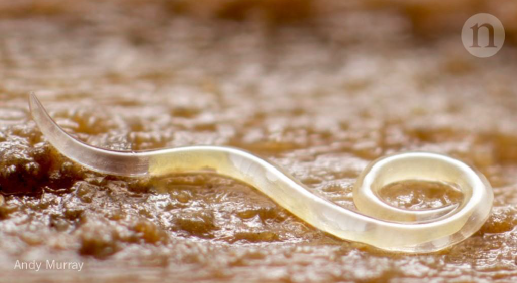
This is an example of a ______, commonly known as roundworms
Nematode
AKA “roundworms”
Nematode: morphologic characteristics
Long cylindrical organisms covered by a cuticle
Have a large body cavity (pseudocoelom)
Nematodes are ______ (two sexes)
Non-hermaphroditic
Males smaller than females
Females have a vulva that may be located near the oral end, tail end, or in the middle
Male nematodes have ____ for grasping females
copulatory bursa (bursates) and copulatory spicules
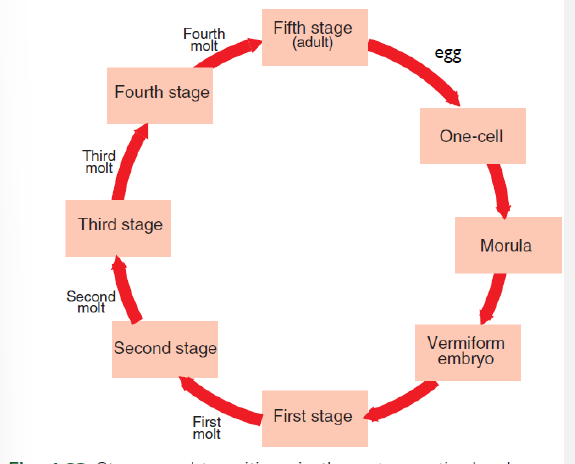
Nematode: Typical Life cycle
egg → one cell → morula → vermiform embryo → 1st stage larva → 1st molt → 2nd stage larva → 2nd molt → 3rd stage larva → 3rd molt → 4th stage larva → 4th molt → 5th stage (adult)
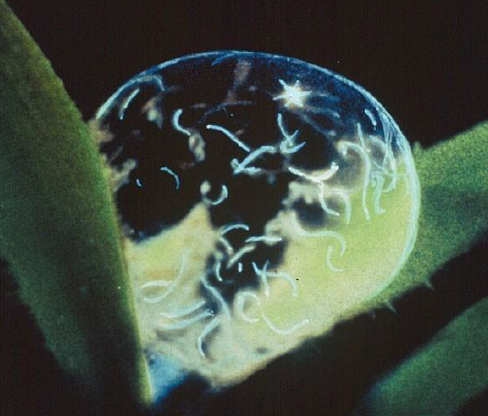
Name this class of nematodes (includes the majority of parasitic nematodes)
Nematoda > Secernentea
What larval stage is the infective stage in the Secernentea class of nematodes?
3rd-stage larva
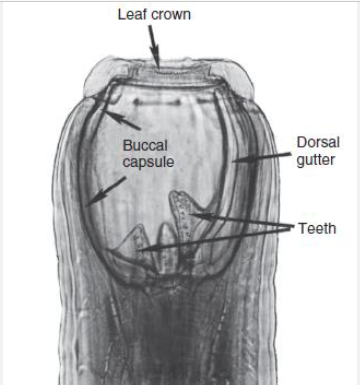
Name this order of Nematodes otherwise known as Bursates
Nematoda > Secernentea > Strongylida (bursates)
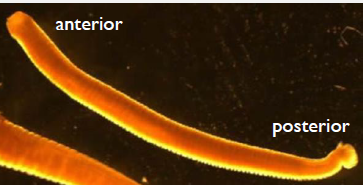
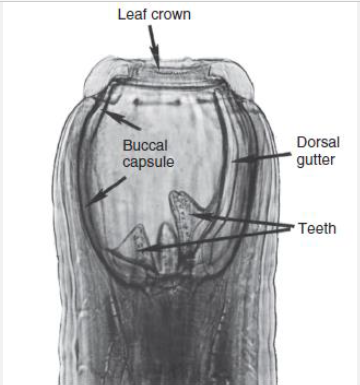
Strongylida: Typical morphologic features
Males typically have a pronounced copulatory bursa (hence the name bursates)
Large buccal capsules for strongyloids and ancylostomatoids
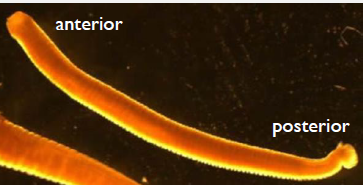
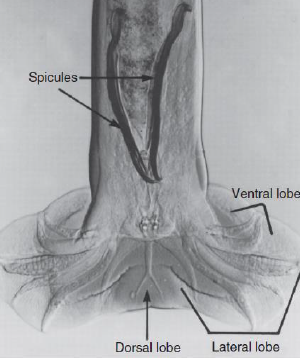
Describe the Spicules of Male Strongyloids and Ancylostomatoids
Spicules are long and thin
Describe the Spicules of Trichostrongyloidea
Spicules are short and stout
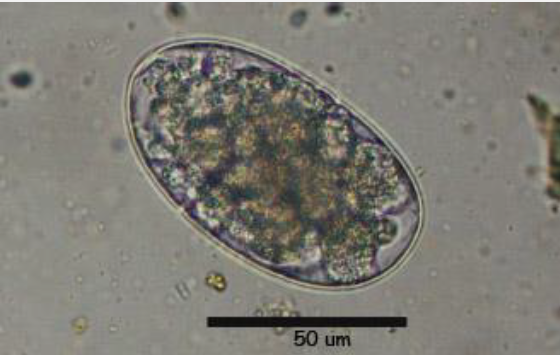
Describe morphological characteristics of Strongylida eggs
typical strongyle-type eggs → smooth, elliptical egg with a morulated embryo
Where do 1st, 2nd and 3rd stage Strongylida larva live?
1st and 2nd stage larvae live in feces
3rd stage larvae migrates out of feces to then be ingested by host
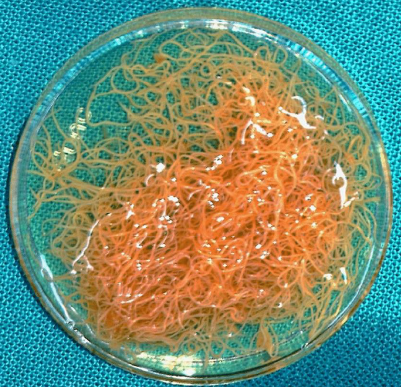
Name this family of nematodes (scientific and common names)
Nematoda > Secernentea > Strongylida (bursates) > Trichostrongylida (threadworms)
Where do Trichostrongylida live and in what hosts?
Common in grazing ruminants, also in swine, horses, cats, and birds
Typically in abomasum and small intestine (exceptions exist)
Where do Dictyocaulus spp. live in host?
Nematoda > Secernentea > Strongylida (bursates) > Trichostrongylida (threadworms) > Dictyocaulus
Exception to typical Trichostrongylida where live in abomasum and small intestine, Dictyocaulus live in the lungs
How is a Trichostrongylida infection diagnosed?
Diagnosis: Strongyle-type eggs on fecal flotation
How is a Dictyocaulus infection diagnosed (differs from other typical Trichostrongylida)?
Baermann technique
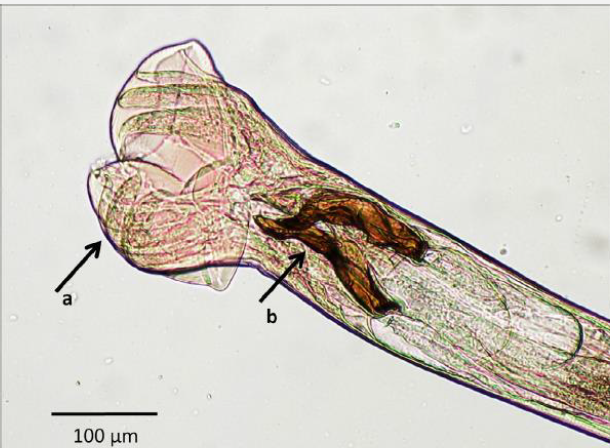
Name this Threadworm
Nematoda > Secernentea > Strongylida (bursates) > Trichostrongylida (threadworms) > Trichostrongylus
Small worms, very reduced buccal cavity
Short, twisted, pointed spicules
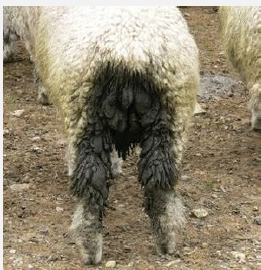
The diarrhea in this sheep is caused by what nematode infection?
Trichostrongylus
Typically asymptomatic, but high numbers can cause diarrhea in sheep, goats, and cattle → Feces on fleece can attract blowflies, leading to myiasis
How does host acquire Trichostrongylus infection? Diagnosis?
Infective third-stage larvae survive winter on pasture, ingested in spring
Diagnosis: Strongyle-type eggs in feces
Trichostrongylus axei: where live and in what host?
Stomach or abomasum of horses and ruminants
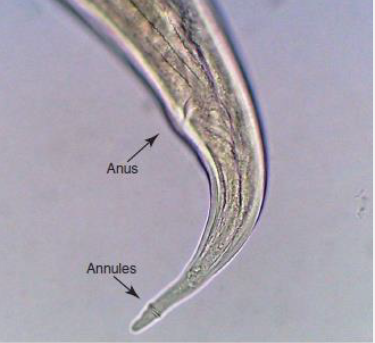
Pictured is the tail of what Threadworm?
Nematoda > Secernentea > Strongylida (bursates) > Trichostrongylida (threadworms) > Ostertagia, Teladorsagia
annulated tail tip
Threadworms Ostertagia and Teladorsagia are related species, but differ in their hosts. What is each one’s host?
Teladorsagia in sheep and goats, Ostertagia in cattle
Teladorsagia/Ostertagia: morphological cahracteristics
Small brownish worms with short buccal cavity, annulated tail tip in females
Short, three-pronged spicules
Where do Ostertagia/Teladorsagia adults live in their respective hosts?
In the abomasum (Ostertagia in cattle, Teladorsagia in sheep)
How are Ostertagia/Teladorsagia infections acquired?
Third-stage larvae survive winter on pasture, ingested in spring
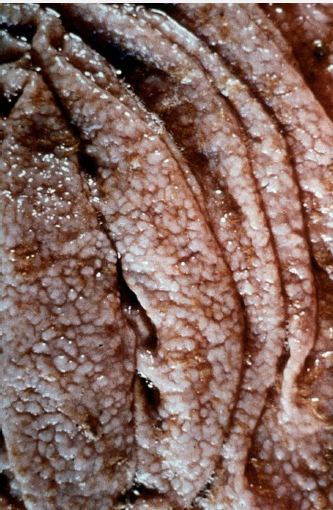
This “Moroccan leather” appearance of abomasal mucosa on necropsy is due to what nematode infection?
Ostertagia (ostertagiasis)
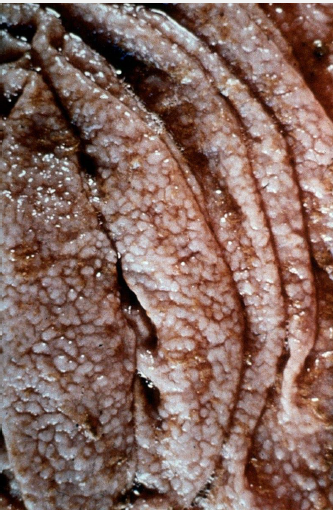
Type 1 Ostertagiasis
Ostertagia infection in cattle
Also called Summer Ostertagiasis
Young pastured cattle acquire the infection in the spring
Clinical signs: diarrhea, anemia, hypoproteinemia, emaciation
Typically in young calves
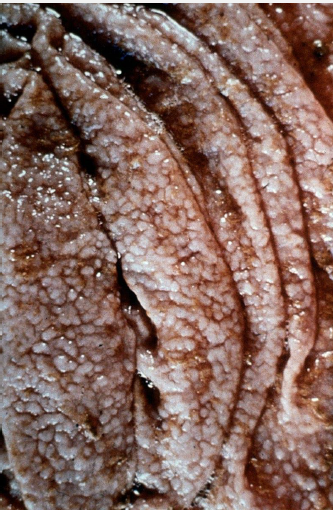
Type 2 Ostertagiasis
Ostertagia infection in cattle
Also called Winter Ostertagiasis
Acquired larvae encyst in mucosa and emerge in late winter
Clinical signs: diarrhea, anemia, hypoproteinemia, emaciation
Typically in young calves
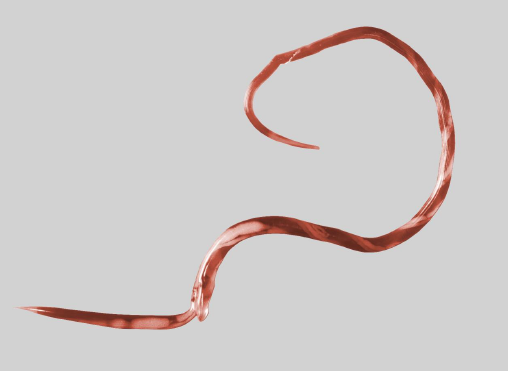
Identify this threadworm: the defining morphological characteristic?
Nematoda > Secernentea > Strongylida (bursates) > Trichostrongylida (threadworms) > Haemonchus
White uterus spirals around blood-filled gut in females → Barber-pole appearance
Where do Haemonchus adults live?
Live as adults in abomasum of ruminants
Haemonchus: Disease
Disease: Anemia, weakness, shortness of breath, submandibular edema (bottle jaw), can be fatal
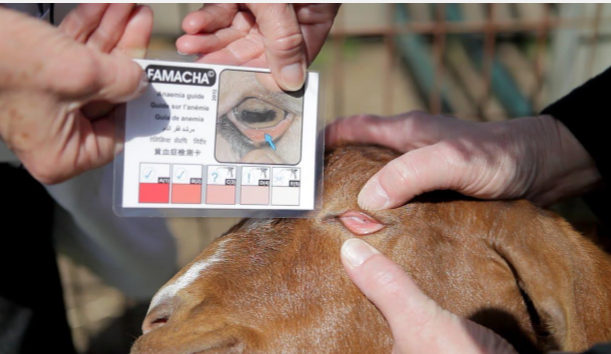
This test is useful for diagnosing what?
FAMACHA chart used to assess mucous membrane pallor
Aids diagnosis of anemia due to Haemonchus infections
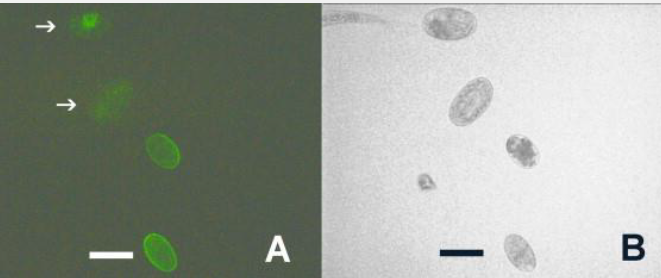
Name this test and what is diagnoses
Peanut agglutination test
Haemonchus eggs
Haemonchus: treatment
Treatment: benzimidazoles (fenbendazole, albendazole), macrocyclic lactones (ivermectin, moxidectin), levamisole, morantel tartrate
Resistance to many drugs reported
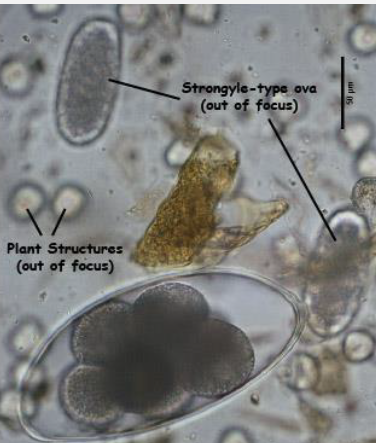
Pictured is a Nematode egg that is much larger than other strongyle-type eggs. Identify the species
Nematoda > Secernentea > Strongylida (bursates) > Trichostrongylida (threadworms) > Nematodirus
Diagnosis: Eggs much larger than other strongyle-type eggs
Nematodirus battus: infective stage development?
Nematodirus battus larvae develop to infective third stage in egg, then hatch after a period of winter freezing
When do Nematodirus battus infections typically occur?
Single wave of infection and disease each spring
Second wave can occur in the fall
Nematodirus: Disease
Typically asymptomatic
Nematodirus battus can cause severe diarrhea and death
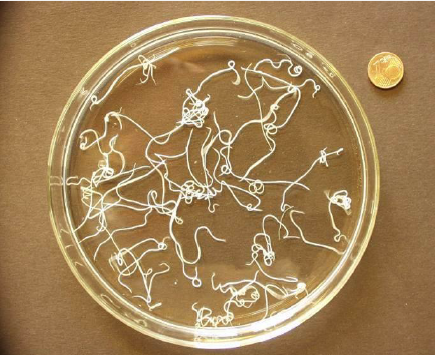
Identify these threadworms
Nematoda > Secernentea > Strongylida (bursates) > Trichostrongylida (threadworms) > Dictyocaulus
Long, white worms with small buccal cavity
Short, granular spicules, reduced bursa
Where do Dictyocaulus adults live and in what hosts?
Live as adults in the respiratory tract of ruminants and horses, first-stage larvae passed in eggs often hatch before passing into feces
Name the host for Dictyocaulus viviparus
Cattle
Name the host for Dictyocaulus filaria
Sheep
Name the host for Dictyocaulus arnfieldi
Equids
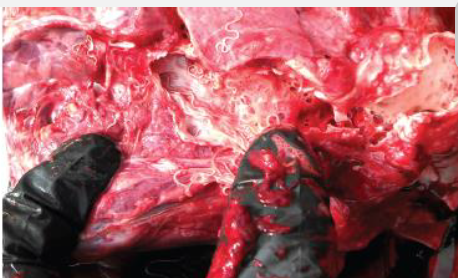
Dictyocaulus: Disease
Disease: Chronic bronchitis, bronchial tree occlusion, atelectasis
(Pictured is a calf lung infected)
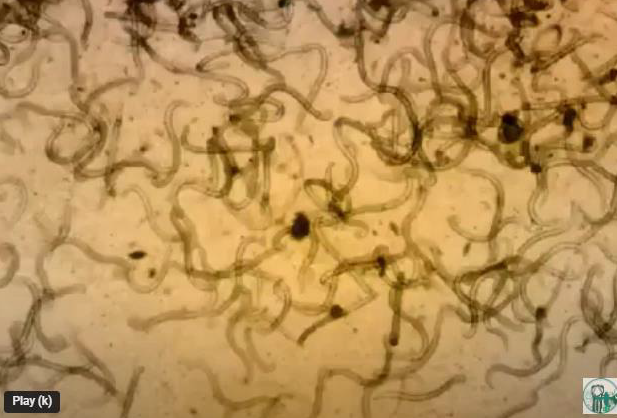
Dictyocaulus: Diagnosis
Diagnosis: First stage larvae in feces detected via Baermann method
Eggs occasionally found on fecal flotation, but usually hatch rapidly
Dictyocaulus: Treatment
Treatment: Macrocyclic lactones (ivermectin, doramectin, moxidectin, eprinomectin), benzimidazoles (fenbendazole, albendazole, oxfendazole), levamisole
Vaccine available
Premunition
The phenomenon where the host is more resistant to a parasite after an initial acute infection has become chronic
A stable adult population of nematodes inhibits further infection or maturation of additional larvae
Spring Rise
Increased number of eggs are passed in feces right before spring
Periparturient rise
Increased number of eggs are passed in feces right before giving birth
Refugia
A population of nematodes that remain unexposed to treatment, decreasing selection pressure on the nematode population as a whole
Resistance to ivermectin, benzimidazoles, and levamisole/morantel reported in many nematode species
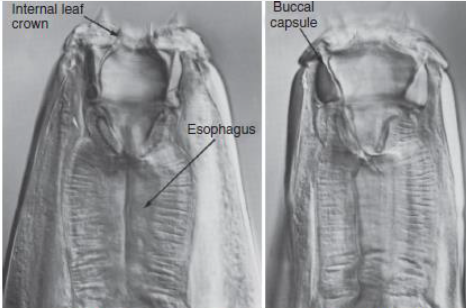
Identify the suborder of Bursates (Strongylida) that show this characteristic of large buccal cavities
Nematoda > Secernentea > Strongylida (bursates) > Strongyloidea
Large buccal cavity surrounded by sclerotized wall
Stomal opening surrounded by lead crown (corona radiata)
Teeth may be present at the base of the buccal cavity
Males have long, thin spicules
Strongyloidea have ______ bodies compared to Trichostrongyloids
Larger and stouter

Identify this Nematode (scientific and common name)
Nematoda > Secernentea > Strongylida (bursates) > Strongyloidea > Strongylus
AKA Large Strongyles
Where do Strongylus adults live and in what host?
Live as adults in large intestine of horses mostly
Larvae undergo migrations throughout body, causing disease
Where do Strongylus vulgaris Fourth stage larvae migrate to?
Fourth stage larvae migrate to cranial mesenteric arteries
Strongylus vulgaris: describe life cycle
Eggs passed in feces develop to environmentally resistant third-stage larvae
Ingested larvae penetrate bowel wall and develop to fourth stage
Fourth stage larvae enter blood vessel walls and migrate to cranial mesenteric arteries
Larvae move through bloodstream to small arteries of intestinal wall
Intestinal walls become inflamed, and larvae break through and mature to adults in lumen of cecum and colon
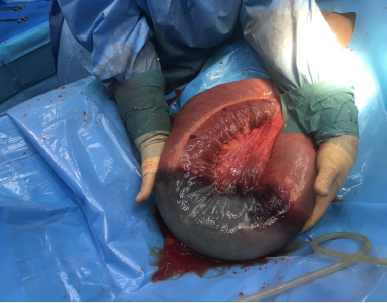
Strongylus vulgaris: Disease
Migration through body can cause arteritis, thrombosis, and embolism of cranial mesenteric arteries → bowel wall infarction is frequent and fatal
Strongylus vulgaris: Diagnosis
Strongyle-type eggs in fecal flotation → indistinguishable from small strongyle (cyathostome) eggs
True or False: Eggs will be passed in feces when Strongylus vulgaris clinical signs develop
False! Eggs may not be passed when clinical signs develop
Treatment: benzimidazoles (febantel, fenbendazole, oxibendazole), macrocyclic lactones (ivermectin, moxidectin), pyrantel pamoate

Pictured is an infestation of what Nematode? (scientific and common name)
Nematoda > Secernentea > Strongylida (bursates) > Strongyloidea > Cyathostomes
AKA Small strongyles
Where do Cyathostomes adults live and in what host?
Live as adults in large intestines of horses, pigs, and wildlife
Larval cyathostominosis
Cyathostomes infestation
Watery diarrhea with hypoalbuminemia in late fall to early spring associated with emergence of large numbers of encysted larvae in mucosa
Considered a rare manifestation of infection

Cyathostomes: Diagnosis
Strongyle-type eggs on fecal flotation
Egg counts can be low in larval-associated disease
Larvae can be detected in feces
Larval culture for L3 identification
Cyathostomes: Treatment
Anthelminthics mostly ineffective for larval cyathostominosis
Moxidectin and fenbendazole has some efficacy against encysted larvae
Adults resistant to most benzimidazoles (fenbendazole, oxbendazole, febantel, etc.) and pyrantel, still susceptible to ivermectin and piperazine
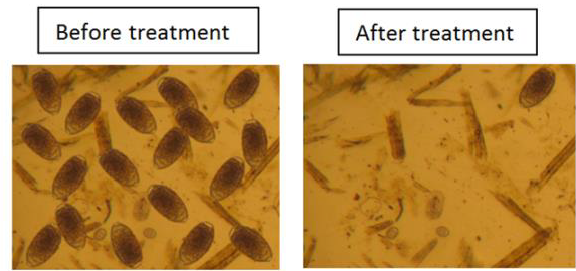
Fecal Egg Count Reduction Test (FECRT)
Recommended yearly by American Association of Equine Practitioners (AAEP) to ensure dewormers are working
Also useful for other species where resistance is a consideration
Deworm and repeat fecal test 10-14 days after initial treatment → Should see 95% reduction in egg count if dewormed is working
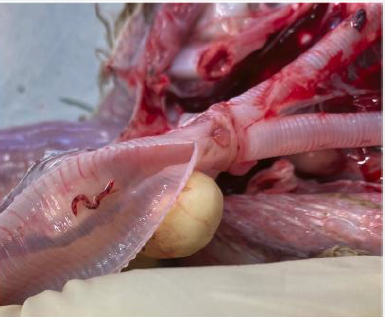
Identify this Nematode (scientific and common name)
Nematoda > Secernentea > Strongylida (bursates) > Strongyloidea > Syngamus
AKA Gapeworm
Male and female Syngamus are ______, making a ______
Males and females permanently joined, making a “Y” shape
Syngamus live as adults where and in what host?
Live as adults in upper respiratory tract of birds
How is Syngamus infection acquired?
Infection via direct ingestion of infective eggs or earthworm paratenic hosts
Syngamus: Disease
Can cause verminous pneumonia (aka lungworm infection), gasping, choking, emaciation, and suffocation due to obstruction
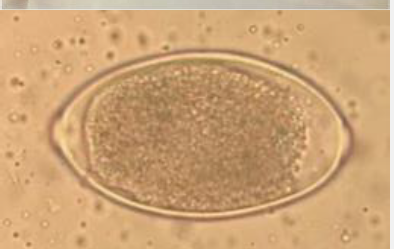
Syngamus: Diagnosis (identifying characteristic?), Treatment
Eggs have bipolar plugs on a fecal flotation
Treatment: Ivermectin, fenbendazole
Practice Question: What life stage of trichostrongyles is considered the infective stage to final hosts?
A. Embryonated Eggs
B. First Stage Larvae
C. Third Stage Larvae
D. Fourth Stage Larvae
Third-stage larvae
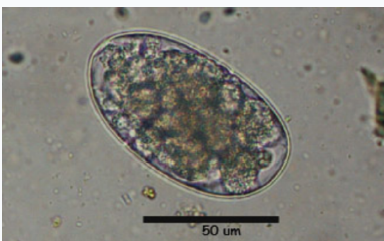
Practice Question: Which of the following is a follow-up test to confirm if this eggs belongs to Strongylus vulgaris?
A. Peanut Agglutination
B. Larval culture
C. Fecal Sedimentation
Larval culture
Practice Question: What is the pathologic lesion caused by ostertagiasis in calves?
A. Multifocal nodules in abomasum
B. Multifocal nodules in intestine
C. Focal necrosis in liver
D. Focal thrombosis in arteries
Multifocal nodules in abomasum (Moroccan leather appearance)
Practice Question: What morphologic characteristic defines Haemonchus spp. aduts?
A. Red and white spiraling tubes
B. Large buccal cavity
C. Male and female fused
D. Three-pronged spicules
Red and white spiraling tubes
Practice Question: What is a clinical finding with Syngamus spp. infection in chickens?
A. Pallor
B. Diarrhea
C. Dyspnea
D. Icterus
Dyspnea

Identify this family of Nematodes (scientific and common names)
Nematoda > Secernentea > Strongylida (bursates) > Ancylostomatoidea
AKA Hookworms
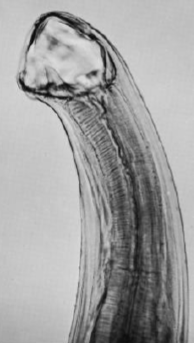
Morphological characteristics of Ancylostomatoidea (Hookworms)
Large buccal cavity +/-teeth, curved dorsally
Well developed bursa in males
Where do Ancylostomatoidea (Hookworms) live as adults and in what hosts?
Live as adults in small intestine of dogs, cats, cattle, and swine
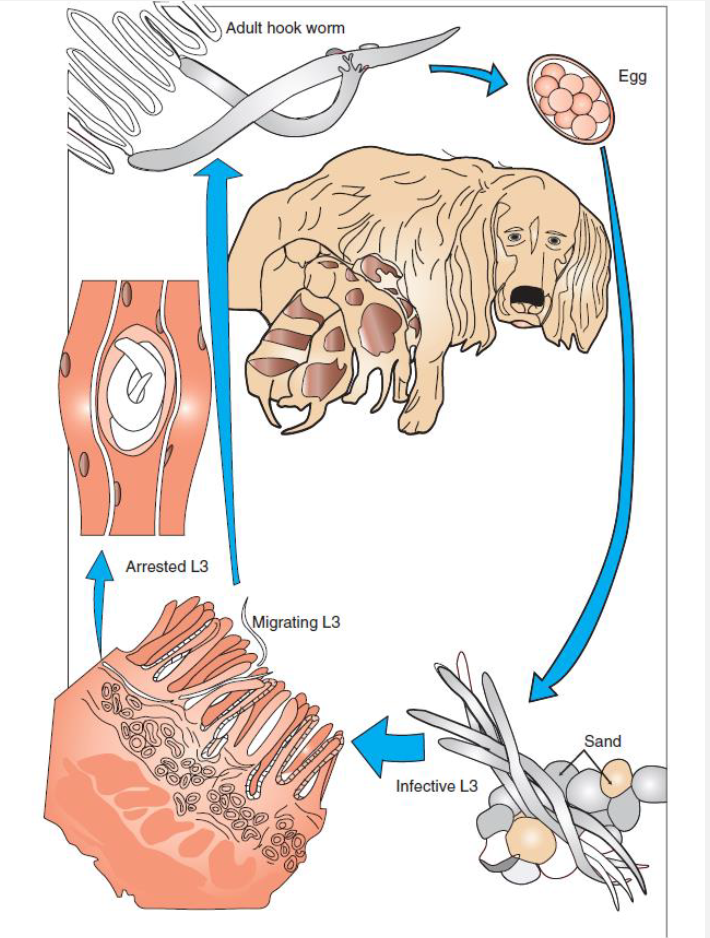
How do hosts acquire Ancylostomatoidea (Hookworms) infection?
Infection via direct ingestion of infective L3 (3rd stage larvae)
Besides ingestion of L3 larvae, what are other ways a host can acquire a Ancylostomatoidea (Hookworm) infection?
Skin penetration of L3 also possible
Transmammary transmission possible in dogs (Infected mothers can shed larvae in milk for next three pregnancies)
Infection via ingestion of paratenic hosts (i.e. rodents, cockroaches) also possible
Ancylostomatoidea (hookworm) larvae do what after infecting a host dog?
Larvae arrest in tissues of dogs > 3 months old (hypobiosis)
True or False: Ancylostomatoidea larvae, once arrested, stay arrested in tissues of dogs
False! Ancylostomatoidea (hookworms) larvae can reactivate and repopulate the intestine or move to mammary glands
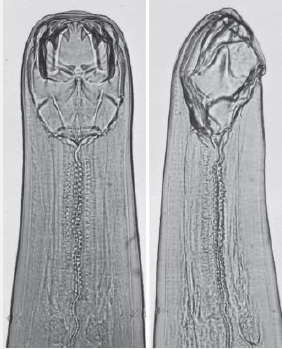
Identify this Ancylostomatoidea (Hookworm)
Nematoda > Secernentea > Strongylida (bursates) > Ancylostomatoidea (hookworms) > Ancylostoma > Ancylostoma caninum
Ancylostoma caninum: Host and morphological features
Dogs
Three teeth
Voracious feeder, more pathogenic
Present throughout U.S.
Ancylostoma duodenale: Host and morphological features
Two teeth
Dogs

Identify this Ancylostomatoidea (Hookworm)
Nematoda > Secernentea > Strongylida (bursates) > Ancylostomatoidea (hookworms) > Ancylostoma > Ancylostoma tubaeforme
Ancylostoma tubaeforme: Host and morphological feature
Cats
Three teeth

Identify this Ancylostomatoidea (Hookworm)
Nematoda > Secernentea > Strongylida (bursates) > Ancylostomatoidea (hookworms) > Ancylostoma > Ancylostoma braziliense
Ancylostoma braziliense: Host and morphological features
Dogs and cats affected
One tooth
More common in southern U.S.

Identify this Ancylostomatoidea (Hookworm)
Nematoda > Secernentea > Strongylida (bursates) > Ancylostomatoidea (hookworms) > Uncinaria > Uncinaria stenocephala
Uncinaria stenocephala: Host and Morphologic feature
Dogs and cats affected
Cutting plates instead of teeth
More common in northern U.S.
Ancylostomatoidea (Hookworm): Disease
Can consume a large amount of host blood → Can cause significant anemia → Severity depends on species and number of worms infecting host
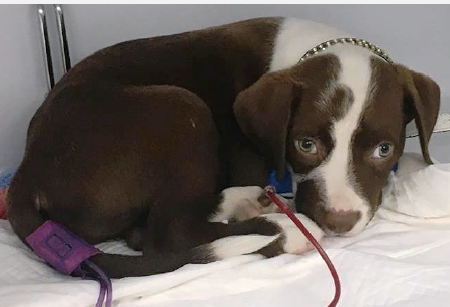
Hookworm Peracute Disease: who affected, signs, prognosis, treatment
Neonatal pups infected via mother’s milk
Pale mucous membranes, soft dark feces
Poor prognosis
Treatment should be started immediately
May require blood transfusions
Hookworm Acute Disease: Who affected, treatment
Older pups and mature dogs exposed to infective larvae
Responds well to anthelminthic treatment
Hookworm Chronic Disease: Who affected, clinical signs
Older dogs infected without clinical signs
Hookworm Secondary(decompensated) disease: who affected, clinical signs
Older dogs with other conditions
Can develop severe anemia that may be fatal

What Nematode can cause this zoonotic infection in humans?
This is cutaneous larva migrans caused by Ancylostomatoidea (Hookworms)
Ancylostoma caninum can produce patent infections in humans