BIO1100 Dr. Morris Troy University Final Exam - Ecology
 Call Kai
 Learn
 Practice Test
 Spaced Repetition
 Match
 Flashcards
 Knowt Play
1/84

There's no tags or description
Looks like no tags are added yet.
85 Terms
Ecology (def, word origin, levels)
= the interactions between all organisms (living things), and interactions between organisms and their environment (temp, moisture, pressure, presence/absence of water, etc.)
From Green word “oikois” = house”
Includes levels of organism, population, community, ecosystem, biosphere
Population (def)
= all individuals of a single species in a given area — have ability to share genetic info (reproduce)
3 ways to analyze population:
Distribution patterns across landscape
Density
Sheer numbers
3 kinds of distribution patterns across landscapes:
Uniform
Clumped
Random
Uniform (diagram, how common, found in what + ex.)
Least common
Sea-going birds
Ex. albatross — will have evenly distributed nests on oceanic islands

Clumped (diagram, how common, why. found in what + 2 ex.s)
Most common
Has to do with resources; based on resources that will be desirable, esp. a hospitable climate
Humans, plants, fish
Ex. humans — tend to clump in coastal areas bcuz large bodies of water make climate milder
Moss — like to grow on streambanks bcuz of moisture

Random (diagram, how common, found in what + 2 ex.s)
Intermediate
Small animals always on the move for food
Ex. insects, lizards

Density
= numbers within a given state
What is the most population-dense state?
New Jersey
What state has the biggest population?
California
Ways of measuring pop. growth:
Exponential Population Growth
Carrying Capacity
Age-Structure Diagrams
Survivorship Curves
What is one example of Exponential Population Growth?
Humans
Human Global Pop. (diagram & important dates, curve shape & why, recent pattern & why)
Chart
Dark ages — decrease due to black plague
Last century — increase due to better medicine, sanitation, transportation & agriculture
J-shaped curve / skyrocketing ← happens when there’s an absence of limiting factors
In recent decades, starting to show signs of stabilization ← due to personal decisions (getting an education shortens the biological clock for having children, now around age 30 as opposed to 20)

Carrying Capacity
= max # of individuals in a pop. that can be supported in a given area over time
Carrying Capacity (diagram & description, curve shape, ex. & why)
S-shaped curve
Ex. AL deer pop. w/managed hunting
Trying to keep it just below carrying capacity, enough resources to support pop.
Helps reduce instances of disease & reduces competition for resources

3 kinds of Age-Structure diagrams:
Rapid Growth
Slow Growth or Zero Growth
Declining Population
Rapid Growth (diagram, description, ex.)
More young ppl > elderly ppl
Ex. Afganistan

Slow Growth or Zero Growth (diagram, description, ex.)
Pop. may have slight growth, but mostly just hovers around same #
Ex. Western world countries — US, Canada, Australia, etc.

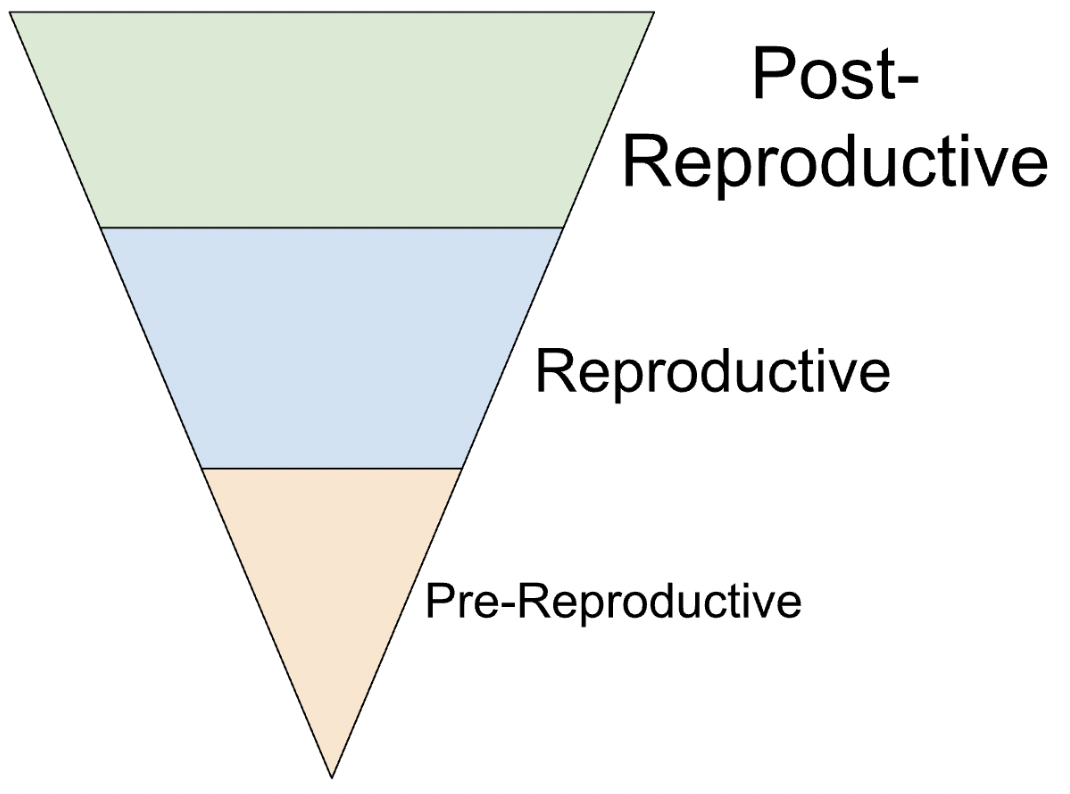
Declining Population (diagram, description, ex.)
Shape of narrow triangle w/broader top
Ex. Italy (many young ppl emigrating), Germany
3 types of Survivorship Curves:
Type I
Type II
Type III
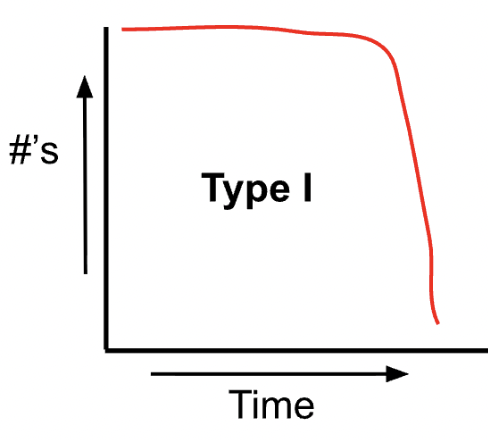
Type I (diagram, why, exhibited by what & 4 ex.s)
High rate of survivorship of young bcuz of significant parental involvement in raising the young
Mostly exhibited by mammals, higher complex organisms (often have low #s of offspring at a time)
Humans
Dolphins
Whales
Bears
Type II (diagram, why, exhibited by what & 2 types w/2 ex.s each)
Generally a diagonal
Any one age group dies off at about the same rate as the other age groups
Young, middle-aged, elderly, etc. all have same risk of surviving
Mostly exhibited by smaller animals
Small reptiles — snakes, lizards
Larger wading birds — herons, egrets

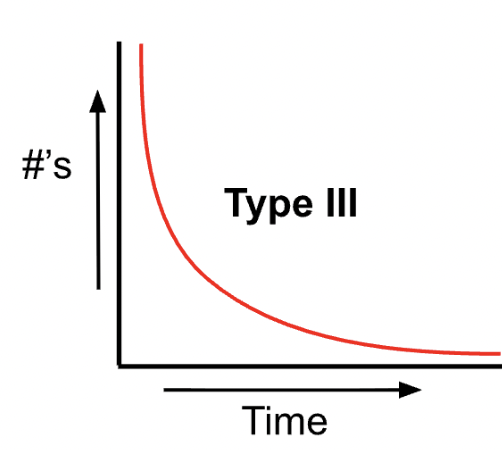
Type III (diagram, why, exhibited by what & 3 types w/1 specific ex.)
High #s in the beginning, most die off early on, just a few will survive to reproduce
Strategy is sheer #s; don’t raise young, leave them on their own and hope some will survive
Fish
Insects
Plants (species that produce a lot of small seeds) — esp. wind-dispersed plants
How to estimate pop. sizes:
Capture, mark, and later re-capture animals
Compare marked : unmarked ratio to estimate pop. size
3 ways of marking pop.s:
Tagging
Banding
Computer chips
(2 sets of) 4 factors that influence population sizes:
Mortality & Emigration → decrease
Birth & Immigration → increase
4 density-dependent factors that influence pop. sizes: (+ predictability)
Food
Space
Shelter
Disease
***How they will influence pop. size is predictable
Food, Space, Shelter (higher pop leads to what, ex. & signs of growth)
Higher pop. → higher competition for these 3 things
Ex. deer — signs pop. is booming:
Coming into gardens bcuz not enough food
Lots of roadkill
Disease (higher pop leads to what, ex.)
Higher pop. → more disease
Ex. college dorm — illnesses like strep throat spreads fast
6 density INdependent factors that influence pop. sizes: (+ predictability, damaging vs. predictability)
Floods
Tornadoes
Hurricanes
Fires
Earthquakes
Volcanic eruptions
***How they will influence pop. size is UNpredictable
***Can be damaging, but beneficial in the long run
Floods (how beneficial, human interferement & 2 solutions)
Water will carry sediments & nutrients into fields → fertile land that can be farmed
Concern bcuz we’ve built dams, levees, and implemented channelization on major rivers → must find other ways to fertilize land;
Fertilizer — must be careful not to over-fertilize bcuz runoff can produce algae, kill fish, etc.
Crop rotation — planting peas/beans (soybeans & peanuts) every few years will naturally fix nitrogen content of soil
Tornadoes (2 ways how beneficial, human interferement & solution)
Can help humans have better building codes & buildings
Can create corridors (“pathways for regrowth)” → sunlight reaches previously shaded areas → formant seeds can germinate & grow → increased diversity
However, humans have brought over invasive species that can take over when these corridors form
Must be careful to monitor invasive species like kudzu
Hurricanes (how beneficial, human intereferement & solution)
Coastal AL, forests are supposed to be semi-open
Way more lightning strikes close to coast than inland → should cause low-intensity fires that would eventually fizzle out on their own
HOWEVER, bcuz of a history of mismanagement, “fuel” (overgrowth) builds up → fires won’t fizzle out on their own → humans must put a stop to them faster before they get out of hand
Hurricane winds can naturally thin out forests;
Allows the fires to do their job and then die out
Can disperse seeds of certain plants — sand pine in South AL & panhandle FL
Fires (in northern vs. southern al)
Generally bad for forests in Northern AL if they don’t have pine trees
Fire is needed in Southern AL — largeleaf pine forests need burning every 3 years
(4) benefits of fires in largeleaf pine forests every 3 years:
Keeps out invasive species & woody underbrush that produce too much shade
Helps to recycle soil nutrients
Stimulates seed germination in plants that are adapted for this
Can promote blooming in plants following the fire
Earthquakes (where)
mostly up north??
Volcanic eruptions (where)
Hawaii, Washington state (Cascade Mt. Range)
Community (def)
= all the living things in a given area & how they interact
Habitat (def + 2 ex.s)
= the place/environment in which the organism lives (ex. herons/egrets live in wetlands, cacti live in desert, etc.)
Niche (def + ex.)
= the functional role of a species in its environment — how does it affect others in its environment? (ex. plants)
What are plants’ niche?
Primary producers — start food chain, benefit everything higher on food chain
Keystone species (def + 2 ex.s)
= organisms that can’t be replaced by other organisms bcuz they are vital to the environment in which they live; benefit other organisms in their environment (ex. gopher tortoise, pisaster starfish)
Gopher tortoise (what, where, home dimensions, 2 ways how benefit other organisms in environment)
Reptile that lives in longleaf pine forests
Dig burrows ~2 meters deep, form tunnels that spread out & can be 40ft in length
Benefit other animals
Have recorded over 40 species of other animals that coexist in these burrows with the gopher tortoise
Mostly other reptiles and amphibians like frogs and toads — to escape storms, predators, fires, the cold, etc.
Benefit plants
Eat the fruits of plants; digest fruit, disperse seeds
Pisaster starfish (what, how benefits other organisms in environment)
Predator
Keeps different species of shellfish in a balance
Eat oysters, clams, scallops, & mussels
Keeps any one of these groups of shellfish from taking over the others
They’ve shown this happening if the starfish is removed
3 Major Types of Interactions in Communities:
Competition
Predator-Prey Relationships
Symbiosis
Competition (def, includes what)
= an interaction btwn 2 diff organisms for a mutually limiting resource; includes invasive species
Principle of Competitive Exclusion (what, how avoided, 2 ex.s)
“When there is competition btwn 2 living things, one of those things is going to get the resource and the other will not & therefore perish/die”
Usually avoided by resource partitioning = subdividing territory for resources
Ex. wood warblers, large plants and grass
How do wood warblers show resource partitioning?
Migratory (i dont think its important)
Diff species can all nest and forage in the same infividual tree by subdividing the tree; maybe going for diff kinds of insects, diff nesting spots, etc.
How do large plants (bushes/trees) and grass show resource partitioning?
Subdividing soil; bush roots go deeper for minerals/water, grass have shallower roots
Invasive species (def, 2 impacts)
= non-native species to the area; not originally found there but somehow moved in at a later time (by actions of humans or by accident)
Disrupt ecosystem & outcompete native species
(4) invasive species in AL:
Kudzu
Chinese privet
Japanese honeysuckle
Fire ants
Coyotes
Wild boars
Kudzu (native to where, how & why got to AL, 2 reasons why was able to spread, 2 affects, 3 ways to control)
Native to Japan
We purposely brought it here
Mostly for erosion control, BUT didn’t help bcuz central root system ≠ spread out
Feeds livestock
Escaped into our natural environments and continues to spread
AL climate is similar to Japan
Natural “checks”/controlling agents didn’t come over w/kudzu
Can’t get into forest at least
Affects:
Outcompetes native plants for water & fertilizer
Mostly outcompetes native plants for light; covers up leaves of tree and can kill tree by shading it to death
How to control:
Burn it
If just getting started, use it
If too much fuel, could cause forest fire
Herbicides & chemicals
Round-Up
Over-exposure to humans can create cancer risk
Biological control
Use a native species (animal) to control a different living thing (plant)
Kudzu bug — also invasive
Certain fungi — project scrapped, also targets pea & bean families
Goats — eat everything that’s vegetation
As a whole, invasive species ______ to control.
cost billions of dollars annually
Chinese privet (aka, native to where, how & why got to AL, 3 reasons why was able to spread, 3 ways to control)
“The worst week in the SE”
Native to China
We purposely brought it here
Thought it’d make a good foundation hedge & screen for privacy
Then it escaped into environment
Birds eat fruits → seed dispersal
Tolerant of shade — can invade forest as well, unlike kudzu
Can reproduce sexually (flowers → fruits) AND asexually (thickets → cloning self)
How to control it:
Burn it
Manual removal
Rip up & pulverize, then vvv
Herbicides & chemicals (Round-Up)
Spot treat stumps
Japanese honeysuckle (native to where, how & why got to AL, short- vs. long-term affects, 3 ways how to control)
Native to Japan
We purposely brought it here
Thought it was attractive, planted as ornamental
Affects:
@ first appears beneficial;
Songbirds nest in it
Feeds deer
Over time, takes over → less food choices → wildlife move out → lowers biodiversity
How to control:
Burn it
Herbicides & chemicals
Biological control (goats)
Fire ants (where native to, how got to AL, spread, 3 affects, 3 ways to control)
Native to South America
Got here accidentally
Floated into ship ballast water, formed living raft
Arrived @ Port of Mobile, AL
Have continually spread — now, all over SE
Affects:
In pastures, danger & nuisance to livestock
Danger to young children
Ground-nesting birds
Northern bobwhite (aka quail)
Needs longleaf pine forests, benefits from frequent fires (eat soft herbs that grow post-burn)
Fire ants have made pop. go ↓ )
How to control:
Chemicals (fire ant killer)
Kick their dirt piles
Coyotes (where native to, how got here, why were able to spread, 2 affects, 2 ways to control)
Native to Western US (Great Plains & West)
Got here partly on purpose, partly due to activity of humans
Stupid ppl in Southern GA purposely brought them over
Clearing forests (to build homes, towns, etc.) provides a mosaic of open fields & patches of woods — just what coyotes like
Spread bcuz
Very adaptable, can live in suburbs or big cities
Affects:
Can bring in disease (rabies) to animals or ppl
Raid chicken houses
How tro control:
Shoot & kill them
Electric fences
What is the hallmark of an invasive species?
Adaptability
Wild boars (where native to, how got to AL, why were able to spread, 2 affects, 2 ways to control)
Native to Northern parts of Europe & Asia
We purposely brought it here
As another game animal
Spread bcuz
Can breed throughout the year
Large litters of young
Affects:
Causes bad erosion — root up vegetation when eating it
Outcompetes native white-tailed deer → deer pop. goes ↓
How to control:
Hunt & eat them
Feeders w/modified rat poison (containing boron) — engineered so boar is only animal with access to food inside
What do animal invasive species support?
Principle of Competitive Exclusion
What is true about predator-prey relationships?
Their adaptations keep making the other one better
Predator
= hunters; can be specific or general
What can specific predators show?
“Boom-and-bust” cycles
Boom-and-bust cycles (chart, description, ex.)
Prey item #s are higher than predator #s in the same general area
Has to do w/calories
Peaks of pop. of predators = a little later than peaks of pop. of prey items
Has to do w/food availability
Ex. lynx cat & snowshoe hare

3 predator adaptations:
Speed
Specialized mouth parts
Heightened senses
Speed (ex + where native to, speed)
Ex. Cheetah — native to Africa, sprints up to 70-75mph
Specialized mouthparts (3 kinds, variety of teeth shows what)
Thick beak curved on top = designed for tearing flesh off bone; ex. bald eagle & other predatorial birds
Short, square (“molar-like”) teeth = for eating plants
Variety of teeth for cutting, tearing, grinding = sign of being very complex/advanced
Piercing mouthparts; ex. mosquitoes, deerflies/horseflies
Heightened senses (3 senses + one in specific’s 2 examples)
Hearing
Vision
Smell
Ex. birds of prey (bald eagle owl, etc.) — poor sense of smell, vision far superior
Bears — sight as good as humans, smell way more powerful than a bloodhound
Prey
= hunted
6 prey adaptations:
Speed
Camouflage & Flash coloration
Warning coloration
Mimicry
Sharp projections
Poisons
Speed (ex. + where native to, speed)
Pronghorn — native to North America, sustained runs up to 55-60mph (fast predator went extinct but it retained its speed)
Camouflage & Flash coloration (2 ex.s + how use colors)
Ex. White-tailed deer
Brown overall coat color = to blend in
White tail = to trick predators (flash tail when running away, then hide again — predators look for white, but won’t see it)
Under-wing moths
Drab outerwings = to blend in (when asleep)
Colorful underwings = to trick predators (when startled, same as deer)
Warning coloration (typical coloration, 3 ex.s)
Usually a combo of bright color against black background
Ex. Poison dart frogs
Monarch butterfly
Coral snake
What kind of plants are generally toxic?
Plants with a milky sap
Mimicry
Ex. Scarlet kind snake — mimics coral snake
Viceroy butterfly — mimics monarch butterfly
Both = toxic, mimicking each other;
Viceroy eats willow tree leaves
Monarch eats milkweeds
Bee fly — mimic bee
Syrphid fly — mimics yellow jacket
Sharp projections (3 kinds + ex.s for each)
***plant-specific!
Spines = modified leaves, hard to break off — ex. Cacti, protect water reserves & food
Prickles can break off and lodge in skin — ex. Blackberries, prevent animals from eating too many plant parts until the right tine when seeds are ready
Thorns = modified branches, can’t really break off — ex. African milk tree
What is the most attractive color combination to vertebrate animals?
Red-on-black coloration
Poisons (2 ex.s, special use of 1)
***plant-specific!!!
Ex. African milk tree — milky sap = very toxic
Madagascar periwinkle — also have milky sap, can be used as chemotherapeutic agents;
Contains vinblastine & vincristine; use diluted version to destroy mitotic spindle in leukemia and lymphoma cancers
In modern conventional medicine, what percentage of all prescriptions are (originally) derived from plants?
anywhere from 20-40%
Some predators are used as what? Give an example.
Biological controls; = 1 living agent controlling another living agent that’s getting out of hand — ex. ladybird beetles (ladybugs) & aphids
Symbiosis
= “living together”
3 variations of symbiosis:
Parasitism
Commensalism
Mutualism
Which variation of symbiosis is most common in nature?
Parasitism (due to sheer #s)
Parasitism
Involves 1 organism taking resources from host organism, harming host
Generalist vs. specific parasites
Generalist parasites often can kill host bcuz it can move to another host
Specific parasites usually won’t kill host bcuz if it did, it would kill itself