Particle Physics
E1
N: has to be a natural number
Rutherford Gold Foil experiment:
Fired alpha particles (2+) at thin gold foil; detected with a fluorescent screen.
Most passed straight through → atom is mostly empty space.
Some deflected → presence of a concentrated positive charge.
Very few (~1 in 8000) bounced back → tiny, dense, positively charged nucleus.
Radius of an atom 10-10m
Fermi radii
Relative atomic mass: Relative atomic mass is the weighted average mass of the atoms of an element compared with 1/12 of the mass of one atom of carbon-12, taking into account the natural abundances of its isotopes.
Photon:
If interact with matter then quantized (explain light feature better)
How light travels then waves explain better
Plancks constant: Gradient of E=hf graph
Electrons are restricted to specific orbits, can go up orbits when hit by a photon at a discrete wavelength, higher frequency needs more energy. Electron occupying higher energy levels, excited can then release discrete wavelengths when going down energy levels. Only works for hydrogen atom,
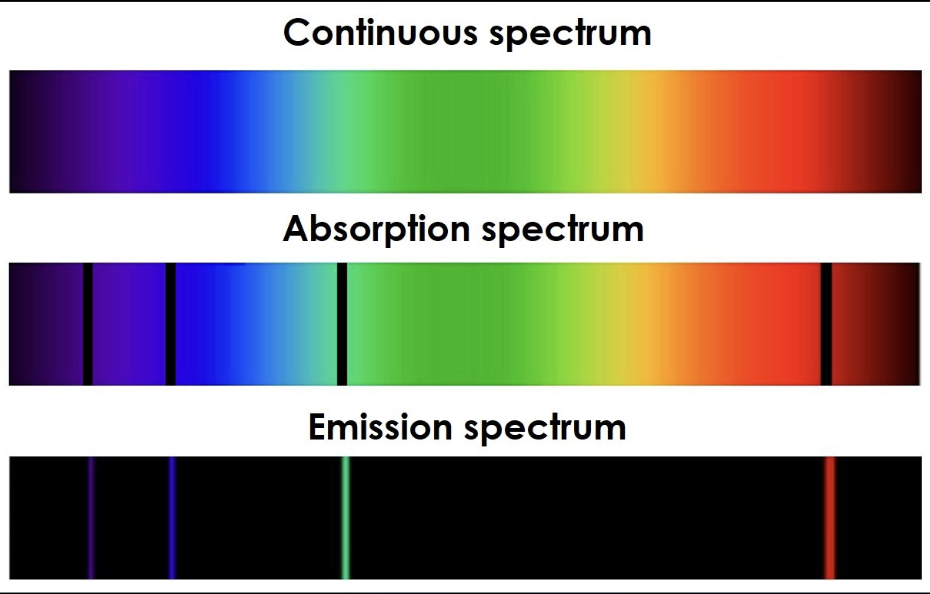
Absorption and emission spectrum are opposite.
Ionization is when one or more electrons are completely removed from the orbitals of an atom
E2
E3
When a nucleus emits radiation, the nucelues, the nucleus is said to go under radiactive decay
A nucleus that emits radiation is unsatble, elements can have both stable
Alpha decay:
2+ Helium nuclei
Happens when Parent nucleus is too large, turning into daughter and alpha particle
Beta decay:
Negative decay is negatively charged electrons, then a neutron will turn int a proton to conserve charge
Positive decay is anti electron, thus proton will turn into a neutron to conserve charge (positively charged electrons)
Change in particle is via the Weak Nuclear force