Data Representation
User defined-data types:
It is a custom data structure designed by a programmer to match the requirements of a program.

Non-composite type -
Enumerated
It is where an identifier can hold a limited number of values {e.g: the days of the week.}
Mainly used for readability, validation, reduced errors and predefined values.

Pointer
A pointer is like a piece of paper that contains the address of a house.
The paper is the not the house itself but give an address to locate the house.
Type inrpointer = ^interger
p ; inrpointer
x ← 50
p ← @x
Pointers are used for memory efficiency, linked list and stack/queues.

Composite Type -
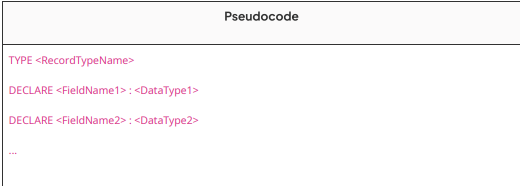
record
Have multiple fields of different data types.

Sets
A composite data type used when duplication is not allowed.
Order is not important
Can perform operation such as union, intersection and difference.

File Organisation & Access -
File Organisation:
The way files are organised for quick retrieval, updates and deletion.
The ways records are arranged is called the file’s organisation method.
File organisation methods:
Serial
records that are stored in the order that they arrived.
Simple, but difficult to search.
Sequential
Records are stored in a sorted order based on their field key.
More efficient to search and used for records that are rarely updated.
Direct (random)
Records that are sorted in a specific location using a hashing algorithm.
Very fast and reliable to search.
What is a hashing algorithm?
An algorithm used to calculate the location (address) where the record is going to be stored.
Used for faster access
Mainly used when it involves a large amount of records and data.
Used in random files and sometime in sequential files.
Types of Hashing Algorithm:
Modulo Division
Folding mehtod.
the key is broken in to pieces and added together.
Mid-square method
Squares the key and use the middle digit as the address.
Multiplicative hashing
Multiplies the key by a constant and uses fractional parts.
Collision Handling Strategies:

Floating-point Numbers, representation and Manipulation -
Floating point Binary:
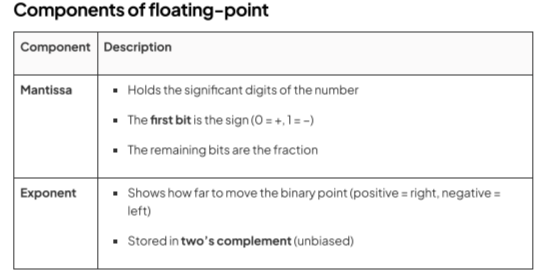
Used to represent real numbers using binary, including fractions and very large or small values.
Utilises limited storage.
More precision
Conversion:
Approximation & Rounding
